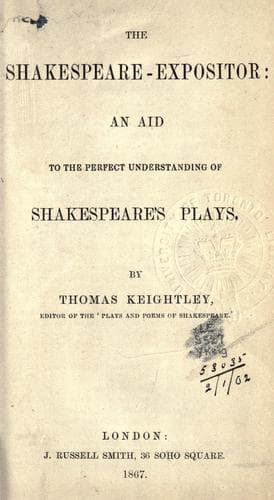
The Shakespeare-Expositor: An Aid to the Perfect Understanding of Shakespeare's PlaysKeightley, Thomas
General
The Shakespeare-Expositor: An Aid to the Perfect Understanding of Shakespeare's Plays
Keightley, Thomas
Drama -- Outlines, syllabi, etc.; Shakespeare, William, 1564-1616 -- Outlines, syllabi, etc.
I do not well understand 'bare' here. Mason read _base_, which is not
quite satisfactory.
* * * * *
"Pray you, go to him.--What should I do _there_?"
* * * * *
"Unheard, what then? * * *
But as a discontented friend, grief-shot."
I would supply _How, then, should I return?_
* * * * *
"Good faith, I'll prove him.
Speed how it will, I shall ere long have knowledge
Of my success."
This is also the punctuation of Delius.
* * * * *
"I tell you he does sit in gold."
For 'in gold' we might read _a god_: "He sits 'mongst men, like a
descended god" (Cymb. i. 7). But it may be his chair of state that is
meant.
* * * * *
"What he would do
He sent in writing after me; what he would not
* * * *
Bound with an oath to yield to his conditions."
A line is lost between the two last lines.
* * * * *
SC. 2. "For I have ever verified my friends--
Of whom he's chief--with all the size that verity
Would without lapsing suffer."
As 'verified' would seem to have been suggested by the following
'verity,' we might read, with Hanmer, _magnified_, or perhaps repeat
'amplified.'
* * * * *
"Out of your gates with sighs."
As 'your' seems utterly unsuitable here, we might read _our_ or _yon_.
* * * * *
SC. 3. "That, if you fail in our request, the blame
May hang upon your hardness."
Pope also saw that 'you' should be _we_.
* * * * *
SC. 4. "_For_ the plebeians have got your fellow-tribune."
* * * * *
SC. 5. "Holp to reap the fame
Which he did end all his."
For 'end' Rowe read _make_; Collier's folio _ear_; Singer, after a
writer in Notes and Queries, reads _ear_ for 'reap,' and _reap_ for
'end.' I would read _inn_ for 'end.' "Give me leave to _inn_ the crop"
(All's Well, i. 3). "All was _inned_ at last into the King's barn"
(Bacon).
* * * * *
"Flutter'd your Volscians in Corioli."
I think Malone was right in reading _Volsces_, and I have followed him.
Volscians is rarely a subst. in this play.
CYMBELINE.
ACT I.
SC. 1. "Our bloods
No more obey the heavens than our courtiers
Still seem as doth the king's."
Tyrwhitt read 'king'; Coleridge _countenances_ for 'courtiers.' It is
better to suppose a word effaced at the end of the second line; so I
add _faces_. A few lines lower they are said to 'wear their faces to
the bent of the kings looks.'
Public-domain text, read in full here on John Shaqi.
Reviews
Reviews
No reviews yet
Be the first to share your thoughts on this work.
Elsewhere in the archive
Join the Discussion
Join the discussion
Sign in to leave a comment or review.
Sign InorCreate an account