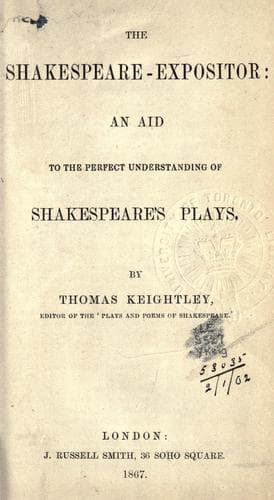
The Shakespeare-Expositor: An Aid to the Perfect Understanding of Shakespeare's PlaysKeightley, Thomas
General
The Shakespeare-Expositor: An Aid to the Perfect Understanding of Shakespeare's Plays
Keightley, Thomas
Drama -- Outlines, syllabi, etc.; Shakespeare, William, 1564-1616 -- Outlines, syllabi, etc.
"Is this most constant wife [TO POST.] who even now."
For 'this' we might read _thy_, or, as I have done, 'this _thy_.'
Without the stage-direction the place has no sense.
* * * * *
"My peace we will begin."
For 'My' Capell read _By_; others _This_.
* * * * *
"Have laid most heavy hand _on_."
ADDITIONAL NOTES.
THE TWO GENTLEMEN OF VERONA.
ACT iv. 4. "And at that time I made her weep a good."
In English we have _good_ and _the good_ as nouns, but never _a good_.
A monosyllabic noun may, then, have been lost, and the poet may have
written 'a good _flood_,' as she "wept bitterly," and we have "_flood_
of tears" (Com. of Err. iii. 2); or 'a good _store_' as we have
"Sham'd their aspects with _store_ of childish drops" (Rich. III. i.
2). Finally, it may have been 'a _flood_,' and the _fl_ having been
effaced, the word was supposed to have been 'good.'
ALL'S WELL THAT ENDS WELL.
ACT v. 3. "Admiringly, my liege." etc.
The folio punctuates "Admiringly my liege, at first I stuck my choice
upon her." The usual reading is "Admiringly, my liege, at first" etc. I
would afterwards read
"_But_ ere my heart
Durst make a too bold herald of my tongue."
We should thus, I think, increase the effect of Bertram's regretful
speech.
KING HENRY IV.--PART I.
ACT v. 3. "I will assay thee, and _so_ defend thyself."
There was no need of correction here; the folio has not 'and,' and
reads 'so defend thyself.' The following has been omitted:--
ACT v. 5. "Had been alive this hoür, _Worcester_."
EXPLANATORY INDEX OF ALLUSIONS, USAGES, WORDS, AND PHRASES.
_A_ (printed 'a or a') is used instead of _'e_ for _he_ when _h_ is
suppressed. Introd. p. 53.
_Able_ (Lear, iv. 6), enable, back, maintain, support. "Admitted! aye
into her heart. I'll _able_ 'em" (Chapman, Widow's Tears, ii); "You
might sit and sigh first till your heart-strings broke. I'll _able_ it"
(ib. iv.).
_Absey_ (K. John i. 1), the _a b c_ or alphabet. The _a_ was perhaps
pronounced as in continental languages.
_Accommodate_ (2 H. IV. iii. 2), to be provided, to be off, like
_accommoder_, Fr. "J'ai découvert qu'elles ne sont pas _fort
accommodées_" (_i.e._ not in very good circumstances) (Molière, Avare,
i. 2).
_Affection_ (Mer. of Ven. iv. 1, v. 1, W. Tale, i. 2), conceit,
imagination. "Lo, which a great thing is affectioun! A man may dye for
ymaginacioun" (Chauc. Miller's Tale).
_Aiery_, or _eiry_, the nest of a bird of prey; and hence (Rich. III.
i. 3), the contents of the nest, the young birds. It is the French
_aire_, which has the same signification, and which, being flat and
unformed, comes from _area_. See Notes and Queries, 3rd S. vi. 43.
_Aim_, in archery. There was a distinction between 'Cry aim' and 'Give
aim.' The former was merely to call on the archer to shoot; the latter
to tell him how his arrow had gone with respect to the aim or mark.
Public-domain text, read in full here on John Shaqi.
Reviews
Reviews
No reviews yet
Be the first to share your thoughts on this work.
Elsewhere in the archive
Join the Discussion
Join the discussion
Sign in to leave a comment or review.
Sign InorCreate an account