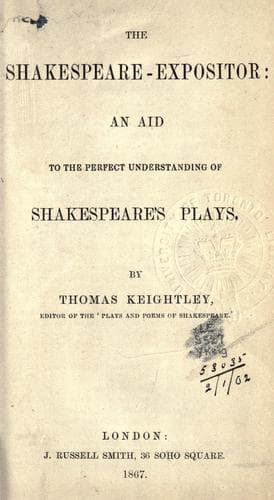
The Shakespeare-Expositor: An Aid to the Perfect Understanding of Shakespeare's PlaysKeightley, Thomas
General
The Shakespeare-Expositor: An Aid to the Perfect Understanding of Shakespeare's Plays
Keightley, Thomas
Drama -- Outlines, syllabi, etc.; Shakespeare, William, 1564-1616 -- Outlines, syllabi, etc.
_Amaimon and Barbason_ (M. W. ii. 2, 1 II. IV. ii. 4, II. V. ii. 1),
names of fiends of which little is known. The dominion of the former
was said to be on the north part of the infernal gulf.
_Ancient_, ensign, ensign-bearer. It is the French _enseigne_ with the
usual paragogic _t_.
_And if_, _an if_, _an_. These are all used for _if_. The first is the
original form, framed perhaps after _etsi_.
_Anon._ Probably a corruption of _in one_, sc. minute.
_Aroint._ This unusual word is generally regarded as an interjection
equivalent to _avaunt!_ but it may be an indicative, with an ellipsis
of _I_, and so be a corruption of _averrunco_.
_Arras_ (so called from the town of that name), tapestry for covering
the walls of rooms. It was fixed on wooden frames a little distance
from the wall; hence people could go behind it. (Much Ado, i. 3, M.
Wives, iii. 3, 1 H. IV. ii. 4, _et alib._)
_Arthur's Show_ (2 H. IV. iii. 2), an exhibition of archery by a
toxophile society, whose members, fifty-eight in number, appeared in
the characters of the Knights of the Round Table. In it Sir Dagonet was
the King's Fool.
_Away_ i.e. _on way_. "She never could away with me" (2 Hen. IV. iii.
2) is, she could not go on the way (_i.e._ agree) with me.
_Backarè_ (Tam. of Shr. ii. 1). The phrase to which it seems to belong
is "Backarè, quoth Mortimer to his sow."
"Ah, sir! _Backarè!_ quod Mortimer to his sowe."
Ralph Roist. Doist, i. 2.
"Shall I consume myself, to restore him now?
Nay, _Backaré!_ quoth Mortimer to his sow."
Heywood, Epig.
"_Backaré!_ quoth Mortimer to his sow;
Went that sow back at his bidding, trow you?"
Id. ib.
"The masculine gender is more worthy than the feminine; therefore,
Licio, _backarè_." (Lyly, Mydas, i. 2).
In all these places it is evidently assumed that the derivation is from
_back_; but it may be that _Bigarrée_, Brindle, was the name Mortimer
had given his sow.
_Baffle_ (_baffoler_, _bafouer_, Fr.), a part of the ceremony of
degrading a knight. It is described by Spenser, F. Q. vi. 7.27.
_Banquet_ or _Banket_. This in general answered to the present
_dessert_, and it was usually served in another room, or in an arbour
(2 H. IV. v. 3). It consisted of fruits, sweetmeats, etc. It also
answered to our supper after a ball (H. VIII. i. 4, R. and J. i. 5),
and was used sometimes for a feast in general. By a "running banquet"
(H. VIII. i. 4, v. 3) seems to have been meant a hasty meal, a snatch,
as it were, of food.
_Basilisco_ (K. John, i. 1), a character in the old play of Soliman and
Persida.
_Baked meat_ (Rom. and Jul. iv. 4), meat-pie. In Webster's White Devil
we have
"You speak as if a man
Should know what fowl is coffin'd in a _bak'd meat_
Afore it is cut up."
Public-domain text, read in full here on John Shaqi.
Reviews
Reviews
No reviews yet
Be the first to share your thoughts on this work.
Elsewhere in the archive
Join the Discussion
Join the discussion
Sign in to leave a comment or review.
Sign InorCreate an account