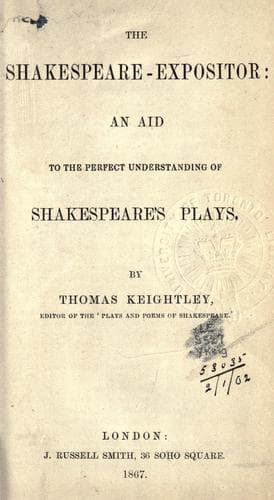
The Shakespeare-Expositor: An Aid to the Perfect Understanding of Shakespeare's PlaysKeightley, Thomas
General
The Shakespeare-Expositor: An Aid to the Perfect Understanding of Shakespeare's Plays
Keightley, Thomas
Drama -- Outlines, syllabi, etc.; Shakespeare, William, 1564-1616 -- Outlines, syllabi, etc.
_Brach._ "A mannerly name for all hound-bitches" (Gentleman's
Recreation, p. 27). "A _brache_ or _biche_, canicula, petite chienne,"
Baret, Dict. This seems to be its meaning everywhere in Shakespeare,
except perhaps Lear, iii. 6, and everywhere else that it occurs.
Jonson and Massinger use it, as _bitch_ is still used by the vulgar,
of a low common woman. Its substitution for that term may have been
caused by the similarity of sound. _Braque_, Fr. (_bracco_ It.), is
a setting-dog; and in the work just quoted we are told the Scotch
called a dog that ran by scent _rache_, "the female thereof in England
is called a _brache_." The Icelandic name of this dog at the present
day is _rakkr_. "Here is a leysche of _ratches_ for to run a hare"
(Skelton, Interl. of Mag.). Golding (Ov. Met. p. 33) uses _brach_ and
_bitch_ as synonymous and of hounds. A _lady-brach_ (Lear, i. 4, 1 Hen.
IV. iii. 1?) seems to have been what we now call a parlour-dog; females
being preferred, probably on account of their greater gentleness. The
above derivation of _brach_ is, however, not quite satisfactory.
_Break across_ (As Y. L. iii. 4), used of a spear, in tilting, when in
the charge its handle was broken by the awkwardness of the tilter. The
mode of doing it, however, is not easy to conceive. Perhaps _break_ was
not used in its usual sense.
_Break up_, carve. It is used (L. L. L. iv. 1) of a love-letter, called
in French _poulet_.
_Breast_ (Tw. N. ii. 3), voice--containing for contained.
_Bribed buck_ (M. W. v. 5), "a buck _cut up_ to be given away in
portions. In O. Fr. _bribes_ were portions of meat which were given
away." So Singer explains it; but I rather suspect it may be a _stolen_
buck. See Richardson, _v._ Bribe.
_Breathe in watering_ (1 H. IV. ii. 4), to take breath while drinking.
It seems to be taken from horses.
"We also do enact
That all hold up their hands, and laugh aloud,
Drink much at one draught, _breathe not in their drink_."
Old Play of Timon, ii. 5.
_Brief_, letter, short writing of any kind, even a verbal promise,
contract, or agreement (All's Well, ii. 3). It may be an adj., with an
ellipsis of the subst.
_Brown paper_ (M. for M. iv. 3). This was one of the useless
commodities which usurers compelled unlucky borrowers to take in lieu
of ready money. Rosini, in his Monaca di Monza, notices it in Italy in
the 16th century; Molière, in L'Avare, in France; and it has continued
in England down to present times.
_Bucklers._ "Give the bucklers" (M. Ado, v. 2) seems to be a term taken
from prize-fighting, signifying to yield, give up. It is supposed that
the bucklers were the prize; but that is not likely. There may be a
use of the plur. for the sing., and the phrase may merely mean lay the
buckler down or aside in token of defeat.
_Budge_ (_bouger_, Fr). In Cor. i. 6 and elsewhere it means to give
back, retire.
Public-domain text, read in full here on John Shaqi.
Reviews
Reviews
No reviews yet
Be the first to share your thoughts on this work.
Elsewhere in the archive
Join the Discussion
Join the discussion
Sign in to leave a comment or review.
Sign InorCreate an account