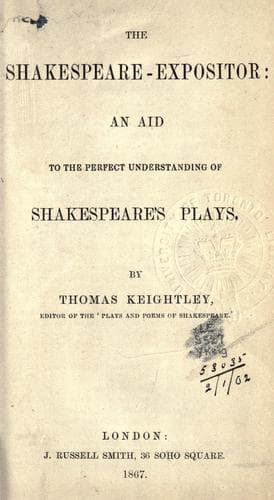
The Shakespeare-Expositor: An Aid to the Perfect Understanding of Shakespeare's PlaysKeightley, Thomas
General
The Shakespeare-Expositor: An Aid to the Perfect Understanding of Shakespeare's Plays
Keightley, Thomas
Drama -- Outlines, syllabi, etc.; Shakespeare, William, 1564-1616 -- Outlines, syllabi, etc.
_Bulk_, breast, chest, not body, as is usually given. In Spanish
_bulto_, a kindred term, is used in the same sense.
_But_ (A.S. _buton_, i.e. _be out_), without, unless, save, except.
It also (it is not easy to say how) took the place of A.S. _ac_, yet,
however; and it became a mere inceptive particle like _now_ and _why_.
When, as it often does, it signifies _that ... not_, as in "Not a man
_but_ was slain," there seems to be merely an ellipsis of the personal
pronoun. So when it signifies _only_ there is an ellipsis of the
negative; for "We have _but_ five loaves" (Matt. xiv. 17) is in A.S.
"We _n_abbð her _buton_ fif hlafas;" and at the present day a peasant
would say "We have_n't but_ five loaves." I therefore, in 1 H. IV. v.
3, read in my Edition for "There is not" "There is not _but_." To my
great surprise I have not been able to meet an exact parallel in any
play or other work. We say "There is _not_ a man _but_ one," etc., and
"I can_not but_ say," etc.; but these are not precisely parallel.
_Buttons._ "It is in his buttons" (M. W. ii. 2), seems to mean it is in
his doublet which is buttoned on him; _i.e._ it is in him, he is able
to accomplish it.
_By._ This prep. sometimes occurs (like _bei_, Germ.) in the sense
of beside, near, in contact with, a sense it still retains, chiefly
in poetry. But by the position given it in our poet it often causes
ambiguity. See Two Gent. ii. 4, As Y. L. iii. 5, and
"If thou be found _by_ me thou art but dead."
2 H. VI. iii. 2.
"To die _by_ thee were but to die in jest."
Ib.
_Cade of herrings_ (2 H. VI. iv. 3), a barrel of _red_ herrings
containing 600, _i.e._ five hundreds of six score to the hundred. See
Notes and Queries, 3 S. ix. 324.
_Calipolis_ (2 Hen. IV. ii. 4), one of the characters in Peele's Battle
of Alcazar.
_Callat_, a term of reproach for a woman. Perhaps it is merely a
corruption of the Irish _cailleach_, old woman, learned from the Irish
costermongers in London.
_Callinó castorè me_ (Hen. V. iv. 4) misprinted _calmie custore me_;
but restored by Boswell from the Handful of Pleasant Delights, 1584,
where it forms the burden of a song beginning with
"When as I view your comely grace,
A callinò castoré me,
Eva, eva, ee, loo, loo, loo, loo, loo, lee,"
of which the last line seems to be unmeaning, and the second to be the
Irish _A colleen óg, astore mo chree_ (A ca{i}lín ó{z} an{st}ó{r} mo
c{r}oiðe) 'Young girl, the treasure of my heart.' The last two words,
it will be seen, are conjectural; and were it good Irish we might read,
An mín 'the gentle one.'
_Camelot_ (Lear, ii. 2), a town in Somerset, where King Arthur was said
to have kept his court. Its site was on a hill, near South Cadbury.
Public-domain text, read in full here on John Shaqi.
Reviews
Reviews
No reviews yet
Be the first to share your thoughts on this work.
Elsewhere in the archive
Join the Discussion
Join the discussion
Sign in to leave a comment or review.
Sign InorCreate an account