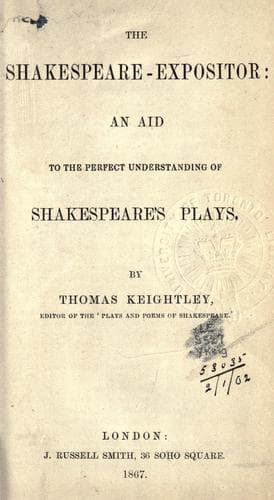
The Shakespeare-Expositor: An Aid to the Perfect Understanding of Shakespeare's PlaysKeightley, Thomas
General
The Shakespeare-Expositor: An Aid to the Perfect Understanding of Shakespeare's Plays
Keightley, Thomas
Drama -- Outlines, syllabi, etc.; Shakespeare, William, 1564-1616 -- Outlines, syllabi, etc.
IN reading and criticising the plays of Shakespeare, we must always
bear in mind that they were written for the stage, not for the
closet, to be acted, not to be read. Shakespeare, as it would appear,
was utterly regardless of literary fame; he had, as we have seen,
one sole object in view, to acquire as much money as would enable
him to quit the hurry and bustle of London, and settle down in his
native Stratford-on-Avon as a man of independent property, and be, if
possible, the founder of a family. Pouring forth, therefore, his tragic
and comic strains, with as little apparent effort as the songsters
of the grove warble their native notes, he set no value on them but
as they filled the Globe and the Blackfriars and thus tended to the
realization of the great object of all his ambition; and he never gave
a single one of them to the press, as was done by Jonson and others
who sought for literary fame by their dramas. Hence, though the verse
is always melodious, we must not look in them for the finish and
perfection which we find in those of a Racine or a Molière; we must,
on the contrary, be prepared to meet with all the marks of haste and
carelessness, with contradictions and even with absurdities. It would
really dismay one to think of their being submitted to the ordeal
through which the pieces of the great Corneille have been made to pass
by Voltaire. Corneille, by the way, like Shakespeare, valued his plays
by the money they produced.
Copies of about one-half of his plays were surreptitiously obtained
by the booksellers, who printed them with more or less of care; but
of this he took no heed: and when he finally retired to Stratford, he
left in the hands of his fellowplayers the manuscripts of his plays,
published and unpublished. There is not the slightest ground for
supposing that he ever had any intention of collecting and publishing
his dramatic writings--a thing of which there had as yet been no
instance. In 1616, the very year of Shakespeare's death, Ben Jonson,
who, widely different from the great dramatist, set a high value,
and a just one, on his plays as literary compositions, collected all
he had written up to that date and published them, with his other
poetical pieces, in a folio volume. It may have been this that induced
Heminge and Condell, two members of the company to which Shakespeare
had belonged, to make a collection of _his_ pieces also, and give them
to the world in a folio volume. For this purpose they used the 4to
impressions of such plays as had been printed, making some corrections
and alterations in them from the playhouse copies; and adding to these
the manuscript plays which were in the possession of the theatre, they
put the whole into the hands of the publishers, one of whom, Edward
Blount, who was a man of some literary pretensions, is supposed, not
without probability, to have undertaken the task of seeing the work
through the press. Such was the origin of the celebrated folio of
Public-domain text, read in full here on John Shaqi.
Reviews
Reviews
No reviews yet
Be the first to share your thoughts on this work.
Join the Discussion
Join the discussion
Sign in to leave a comment or review.
Sign InorCreate an account