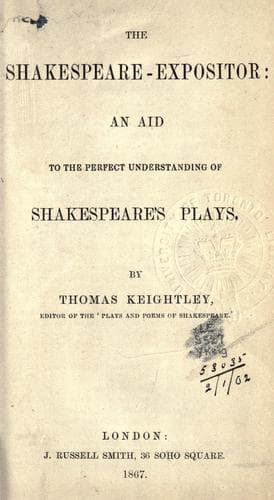
The Shakespeare-Expositor: An Aid to the Perfect Understanding of Shakespeare's PlaysKeightley, Thomas
General
The Shakespeare-Expositor: An Aid to the Perfect Understanding of Shakespeare's Plays
Keightley, Thomas
Drama -- Outlines, syllabi, etc.; Shakespeare, William, 1564-1616 -- Outlines, syllabi, etc.
1623, of which it was, in my opinion most justly, said by the late
Mr. Hunter, that "perhaps in the whole annals of English typography
there is no record of any book of any extent and any reputation having
been dismissed from the press with less care and attention;" while Mr.
Knight (who ought to have known a good deal about such matters) boldly
declares that "perhaps, all things considered, there never was a book
so correctly printed!" Such as it is, however, it and the previous 4to
impressions are the _only_ authority we have for the text of these
marvellous creations of the human intellect.
2.
Few, I should hope, will refuse to assent to the two following
postulates.
I. No eminent writer--however he might obscure his meaning by
metaphor, ellipsis, or other figures of speech--has ever written pure
nonsense.
II. No true poet ever wrote limping, imperfect, or inharmonious verses.
We may add to these the plain facts, that printers are not, and never
were, infallible, and that those works of which the authors themselves
read the proof-sheets are in general more correct than those of which
those sheets were read by others.
3.
Now the plays of Shakespeare are, as is well known, full of passages
of which it is nearly impossible to make any good sense, and they
abound in imperfect and inharmonious verses. On the other hand, the
poems of Venus and Adonis, and of Lucrece, which he himself probably
saw through the press, are almost entirely free from error, and do not
contain a single unmelodious verse. The natural inference, then, is,
that the defects of the plays are all owing to the transcribers and
printers, and that the correction of them and the restoration of sense
and melody, when possible, is the legitimate office of sound emendatory
criticism. The truth of this has been felt from the very beginning; for
in the 2nd folio, published in 1632, only nine years after the first,
there are numerous corrections, which must have been made by the editor
solely on his own authority, for, many of them being very bad, he could
not have derived them from any manuscripts. And the same is the case
in the subsequent folios, of all of which there are many copies in
existence, like that which Mr. Collier met with to his misfortune, and
which has excited such a storm in a puddle,--of which, by the way, my
own opinion is that the corrections in it were made between 1744, the
date of Hanmer's, and 1765, that of Johnson's edition; whence I only
cite it for the corrections later than the former date. These contain
manuscript corrections, some, like that copy, anonymously, others by
Southern and other men of repute. In the beginning of the last century
Rowe gave the first example of an annotated edition of Shakespeare's
works, and from that time to the present edition has succeeded edition
bearing the names of critics of various degrees of ability and
eminence, but all agreeing in the necessity of revising the text and
Public-domain text, read in full here on John Shaqi.
Reviews
Reviews
No reviews yet
Be the first to share your thoughts on this work.
Join the Discussion
Join the discussion
Sign in to leave a comment or review.
Sign InorCreate an account