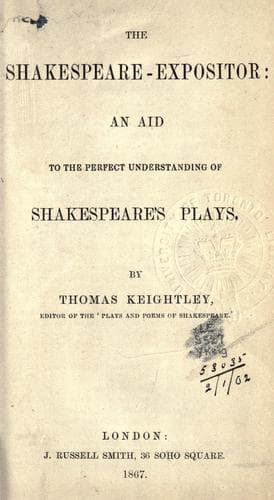
The Shakespeare-Expositor: An Aid to the Perfect Understanding of Shakespeare's PlaysKeightley, Thomas
General
The Shakespeare-Expositor: An Aid to the Perfect Understanding of Shakespeare's Plays
Keightley, Thomas
Drama -- Outlines, syllabi, etc.; Shakespeare, William, 1564-1616 -- Outlines, syllabi, etc.
rendering it as correct as may be possible.
Of the early editors, Rowe and Pope made little more than the most
obvious corrections, Warburton, always ingenious and almost always
wrong, made notwithstanding some that were very good, as also did
Hanmer. But they were all eclipsed by Theobald, one of the acutest
emendatory critics that this country has produced, whose merits, though
long clouded through the malignity of Pope, are now fully acknowledged.
Capell, the next in order of time, also rendered good service; but
Johnson, Steevens, and Malone have done much less than might have
been expected. Of these the last was a native of Ireland, the only
emendatory critic that country has produced; and, in my opinion, he is
not at all inferior to his English rival Steevens. That true critic
Tyrwhitt should also be noticed as an emendator of a high order. It
is surprising how little has really been done in the present century;
and I was perfectly astonished to find what a number of passages still
remained in a corrupt or imperfect state when I ventured on the task
of emendation. It would seem as if critical sagacity, low in rank as
it may be, is one of those talents most rarely bestowed; and besides,
print appears to exercise almost a magic power over most persons; they
seem to think that what is in print cannot be wrong: it is in fact only
very few minds that can fully emancipate themselves from its influence.
It must, however, be remembered that alteration and critical emendation
are widely different. The former is in the power of almost any one; the
latter, as I said, requires a peculiar faculty. It is a curious fact
that in nothing does critical sagacity show itself more than in, as I
may say, seeing what is before the eyes. For an instance see the first
note on Henry V. Another curious fact is this, that poets (Coleridge
for example) are rarely good emendators. It is, in fine, the merest
folly, and a proof of the grossest ignorance, to sneer at such labours
and represent them as needless, if not mischievous. Editors, however,
ought to be very cautious about introducing their conjectures into the
text, and should place them only in notes, unless when they are such
as must almost command assent, and the place corrected had previously
yielded no tolerable sense or metric melody. It is a good rule to let
well alone, as we say, and not to alter what gives tolerable good
sense. I have, I believe, transgressed this rule only in a couple of
places.
4.
Public-domain text, read in full here on John Shaqi.
Reviews
Reviews
No reviews yet
Be the first to share your thoughts on this work.
Elsewhere in the archive
Join the Discussion
Join the discussion
Sign in to leave a comment or review.
Sign InorCreate an account