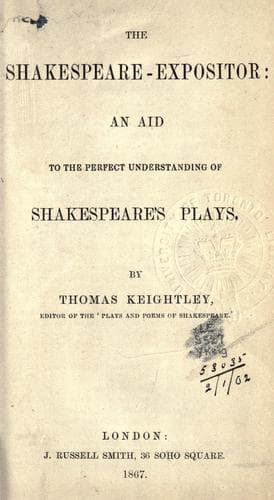
The Shakespeare-Expositor: An Aid to the Perfect Understanding of Shakespeare's PlaysKeightley, Thomas
General
The Shakespeare-Expositor: An Aid to the Perfect Understanding of Shakespeare's Plays
Keightley, Thomas
Drama -- Outlines, syllabi, etc.; Shakespeare, William, 1564-1616 -- Outlines, syllabi, etc.
The following instance is a convincing proof of the evil consequences
of the proof-sheets not having passed under the author's own eye.
Sismondi, the celebrated historian of France, wrote an historic tale
named Julia Severa, which was of course written in French, and it was
printed at one of the best offices in Paris; but the author himself did
not see the proofs, whence, though it makes only two rather slender
duodecimo volumes, there are actually whole pages of _errata_! I
know, by the way, no better mode of weaning oneself from what I shall
presently describe as _printer-worship_ than a habit of examining
the _errata_ in books printed in the two last centuries. Further, in
good printing-offices, at least in this country, it is the practice
that the proofs, after they come from the compositor, should be read
in the office and corrected before they are sent to the author or
editor; while, even at the present day, in the Royal printing-office
in Copenhagen there are no readers, and the sheets are sent out just
as they come from the compositor, and what that state is must be known
to any one conversant with printing-offices. Now it is very possible,
or rather highly probable, if not certain, that such was the case in
England also in former times; and supposing that it was the editors,
and not Blount, that read the proofs, as the wretched state of the
punctuation might seem to indicate, we need not feel any surprise at
the very unsatisfactory state of the text of the folio of 1623. In
opposition, however, to this opinion, the Cambridge editors think that
"there were no proof-sheets, in those days, sent either to author or
editor," and that "after a MS. had been sent to press it was seen only
by the printers, and one or more correctors of the press employed by
the publishers for that purpose." But on this hypothesis how are we
to account for the great correctness of our author's Poems, Spenser's
Shepherd's Calendar, the Works of Jonson, Drayton, and others? The
following words on the title-page of Marston's Fawne, 2nd edition,
offer decisive evidence that authors _did_ read the proof-sheets of
their works:--"Now corrected of many faults, which, by reason of the
author's absence, were let slip in the first edition."
5.
Public-domain text, read in full here on John Shaqi.
Reviews
Reviews
No reviews yet
Be the first to share your thoughts on this work.
Elsewhere in the archive
Join the Discussion
Join the discussion
Sign in to leave a comment or review.
Sign InorCreate an account