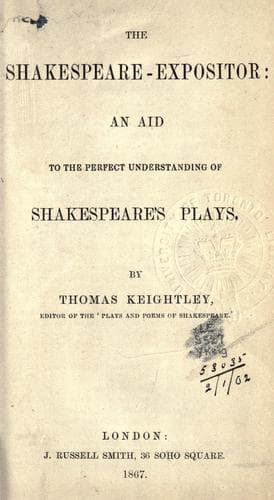
The Shakespeare-Expositor: An Aid to the Perfect Understanding of Shakespeare's PlaysKeightley, Thomas
General
The Shakespeare-Expositor: An Aid to the Perfect Understanding of Shakespeare's Plays
Keightley, Thomas
Drama -- Outlines, syllabi, etc.; Shakespeare, William, 1564-1616 -- Outlines, syllabi, etc.
Notwithstanding all this, there are editors of Shakespeare who,
rejecting the evidence of sense, grammar, and logic, obstinately adhere
to the printed text, terming that alone _authority_, and even holding
the second and later folios to be such; and it is really pitiable to
see them superstitiously retaining for instance _'tis_ or _it's_ when
the metre requires _it is_, and syncopated forms as _lov'd_, _own'd_,
etc., when the verse has need of the complete word, and _vice versâ_.
These I denominate _Printer-worshipers_; for it is in reality to the
authority of the printer, not of the poet, that they bow. The most
extraordinary instance of this propensity in existence is the retention
of "strain _at_ a gnat" in our authorized version of the New Testament,
a most manifest printer's error; for no schoolboy could have made it
in translating, and in all the previous English versions the word is
_out_. Yet there it has stood uncorrected for two centuries and a half!
Hardly inferior as a piece of printer-worship is the following. A
stanza of a song in Fletcher's Spanish Curate (ii. 5) ends thus:
From that breath, whose native smell
Indian odours far excel,
thus expressing the very contrary of what was meant! Theobald, a true
critic, therefore most properly added _doth_--in the wrong place,
however, as it should begin the line; yet Mr. Dyce says, "the old text
is doubtless what the poet wrote"!!
To conclude, then, if the printed text cannot be made to yield sense
the fault _must_ lie, not with the poet, but with the transcriber or
the printer, and a correction, made in conformity with the language
and mode of thinking of the poet and his time, as it _may_ give what
he wrote, or may have written, should be admitted into the text. I
must here, _en passant_, impress it on the reader as a maxim, that no
word should be used in correction that is not to be found in the poet
himself, or in his contemporaries.
6.
Public-domain text, read in full here on John Shaqi.
Reviews
Reviews
No reviews yet
Be the first to share your thoughts on this work.
Elsewhere in the archive
Join the Discussion
Join the discussion
Sign in to leave a comment or review.
Sign InorCreate an account