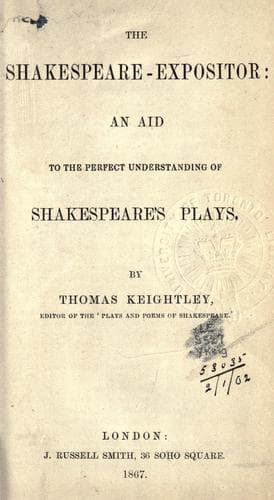
The Shakespeare-Expositor: An Aid to the Perfect Understanding of Shakespeare's PlaysKeightley, Thomas
General
The Shakespeare-Expositor: An Aid to the Perfect Understanding of Shakespeare's Plays
Keightley, Thomas
Drama -- Outlines, syllabi, etc.; Shakespeare, William, 1564-1616 -- Outlines, syllabi, etc.
A printer is a transcriber or copyist, with the only difference that he
uses type instead of a pen. He looks at the _copy_, as it is termed,
and takes up the whole or part of a sentence in his mind, and then goes
on composing or setting up the type. Meanwhile he is very possibly
engaged in conversation, or he is listening to that of others, or he
is thinking of something else. His mind being thus distracted, errors
will naturally arise in what he is composing. Besides, he has very
often to contend with the difficulties caused by illegible writing in
the manuscript. There is another source of error--and one in which
the printer is perfectly blameless--which I have never seen noticed.
It is this, that in speaking and reading we often slur over, elide
or suppress the final consonant if the following word begin with a
consonant; and this is not peculiar to the English, but is to be found
in the French, German, and other languages, being in fact a law of
nature, the result of our organization. The most usual case is when,
as in the following example, the first word ends and the next begins
with the same consonant. Thus in one of the Irish Melodies of Moore, a
poet more devoted to euphony than to sense, we have
Thou would_est_ still be adored as this momen_t_ thou art,
where it will be seen that the letters in italics are not, and cannot
be pronounced, without making a pause between the words. In another
song of the same poet we have
Mary, I believed thee true,
And I was blest in thus believing.
Here, if it were not for the second line, no one, on only hearing the
first, could tell whether the word was _believed_ or _believe_; for the
sound is exactly the same: see on Much Ado, iv. 1; M. N. D. ii. 1. We
surely then cannot blame the printer who makes a mistake in such cases,
but we should not hesitate to correct it. We should also remember that
this suppression or clipping is more frequent with the classes to which
the printer probably belonged than with the educated.
It is chiefly the dentals _t_ and _d_ that are thus suppressed before
words commencing with a mute consonant; and it is surprising what a
number of words there are in common use that have been thus curtailed.
Thus in _and_ the _d_ is rarely sounded, even before vowels; _of_ is
so generally pronounced _o'_ that it were needless printing it so, as
is usual in the dramatists, were it not that _o'_ represents _on_ as
well as _of_; we all say "_Who_ did you see?" though we should write it
"_Whom_ did you see?" Instances, in fine, are numberless; but we should
keep the principle constantly in mind. See the note on _sly-slow_,
Rich. II. i. 3; and on _by peeping_, Cymb. i. 7.
On the other hand, there is sometimes a transference of a consonant
from the end of one word to the beginning of the next, which injures
the sense,--_ex. gr._,
Public-domain text, read in full here on John Shaqi.
Reviews
Reviews
No reviews yet
Be the first to share your thoughts on this work.
Elsewhere in the archive
Join the Discussion
Join the discussion
Sign in to leave a comment or review.
Sign InorCreate an account