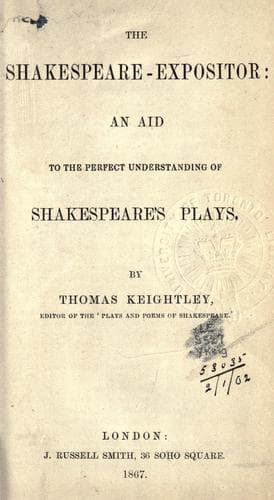
The Shakespeare-Expositor: An Aid to the Perfect Understanding of Shakespeare's PlaysKeightley, Thomas
General
The Shakespeare-Expositor: An Aid to the Perfect Understanding of Shakespeare's Plays
Keightley, Thomas
Drama -- Outlines, syllabi, etc.; Shakespeare, William, 1564-1616 -- Outlines, syllabi, etc.
In Chaucer's Romaunt of the Rose, the transpositions in the latter
part are so numerous that it was necessary to have recourse to the
original poem for the proper arrangement; and I suspect that this
source of error will be found in most languages. Mr. Brandreth, in
his very curious and interesting edition of the Ilias, has made many
transpositions, and they are well deserving of attention. His note on
Il. i. 18, is "Verborum transpositio tutissimum remedium est, cum
saltem, quoad grammaticam, ita dixisse potuerit poeta. Recitatores sæpe
verba retinent, dum ordinem obliviscuntur." This most exactly accords
with what we find in Shakespeare. I think also that many might be,
as some have been, made in the poetic and prophetic books of the Old
Testament--_ex. gr._,
"Ye mountains of Gilboa, no dew nor no rain be upon you, and fields
of offerings; for there" &c.--2 Sam. i. 21.
Now surely the royal poet must have written,
Ye mountains of Gilboa, and fields of offering!
No dew and no rain be upon you:
and it appears still more certain when we look at the original Hebrew.
A chief cause of errors of this kind seems to have been the addition,
by the author, of one or more lines to a place which he had previously
deemed complete, and this addition, having been made in the margin,
was taken in by the printer in the wrong place; as such I regard the
transposition in M. N. D. ii. 1. Another cause was the omission of
something by a transcriber, who, when he detected his error, wrote
what he had left out in the margin, and the next transcriber or the
printer carelessly inserted it in the wrong place. Of this we have very
striking instances in the Chorus to Hen. V. ii., 2 Hen. VI. iii. 1, and
Rom. & Jul. iii. 3. As in these cases, entire lines or even couplets
get out of place, sometimes parts of lines (King John, iii. 3, Rich.
II. v. 3), at other times single words. Thus adjectives change places
(Temp. i. 1. iv. 1), and substantives do the same (All's Well, ii. 3,
M. N. D. ii. 1, L. L. L. iv. 3). The following is a notable instance.
In Massinger's Maid of Honour (i. 1), a play of which the proofs were
probably read by the poet himself, we read, "A gentleman and yet no
lord," where the context shows that the very opposite is meant. Gifford
saw this, but he did not see the cause, namely, that _a_ and _no_ had
changed places in the printer's mind.
I have remarked several errors of this kind in Chaucer, in whom, in
fact, they are most numerous--_ex. gr._,
And eke in his hert had compassioun.
_And in his hert eke had compassioun._
And pitous and just and alway y-liche.
_And just and pitous and alway y-liche._
That it was a blissful noise to here.
_That it a blissful noise was to here._
In the Faerie Queene, we have
Was like enchantment, that through both his _eyes_
And both his _ears_, did steal his heart away.
vi. 2. 3.
Public-domain text, read in full here on John Shaqi.
Reviews
Reviews
No reviews yet
Be the first to share your thoughts on this work.
Elsewhere in the archive
Join the Discussion
Join the discussion
Sign in to leave a comment or review.
Sign InorCreate an account