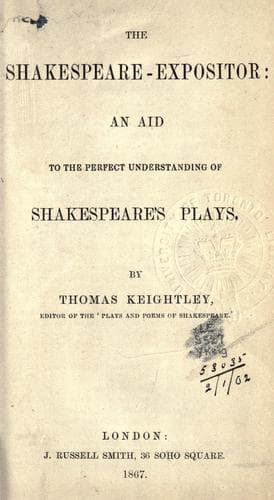
The Shakespeare-Expositor: An Aid to the Perfect Understanding of Shakespeare's PlaysKeightley, Thomas
General
The Shakespeare-Expositor: An Aid to the Perfect Understanding of Shakespeare's Plays
Keightley, Thomas
Drama -- Outlines, syllabi, etc.; Shakespeare, William, 1564-1616 -- Outlines, syllabi, etc.
Here, as the riming line ends in _appears_, we must transpose "eyes"
and "ears." Again, in all editions of Parnell's poems, from the first
(edited by Pope), we read in the Hermit,
Then with the sun a rising journey went,
where both the context and common sense show that "rising" properly
belongs to "sun." The original printer, however, joined it with
"journey," and he has been, of course, duteously followed by his
successors, while editors never seem to have discerned the incongruity.
In the edition of Akenside above mentioned, I met with
Of triangle or circle, cube or cone,
where it is quite plain that the two first substantives had changed
places in the printer's mind.
Surely Wordsworth did not write
I did not hunt after nor greatly prize.
Prelude, ed. 1858.
In a proof-sheet of my Edition, I found
And leave your brother speed to gos elsewhere.
3 Hen. VI. iv. 1.
In Troilus and Cressida, v. 2, there is a passage to which
transposition, and it alone, gives sense. It is difficult to see how
the printer could have made such a jumble; and yet it is manifest that
he must have done so. There is, however, as I have shown in my note
on the place, just such another in the play of The Two Noble Kinsmen,
which the editors have made no attempt at correcting. In the following
passage of Chaucer,
Tooke my horse and forthe I went,
Oute of my chaumbre; I never stent.
Book of the Duchesse.
I would read
Oute of my chaumbre forthe I went,
And tooke my hors; I never stent.
In the same poet's Romaunt of the Rose, we have the following passage,
unnoticed by any editor,
Thine armys shalt thou sprede abrode
As man in warre were forweriede,
where in the first line we should read "abrode sprede," and in the
second reject "were" as an addition of the copyist. An exactly similar
transposition occurs in a later part of that poem.
10.
_Substitution._--"He who has not repeatedly observed how a copyist,
from inattention, sets down a word which his mind has presented to
him instead of that which is before his eyes, must have seen little
of copies of print or manuscript." These are the words of a Spanish
writer, and they are of universal application. I remember myself once,
with Herodotus before my eyes, writing _Sestos_ for _Abydos_; and the
changes I have made in copying passages for this work have amazed me.
In Corneille's play of Rodogune (i. 1), we read _enlever_ where the
proper word is _élever_, and Voltaire justly suspected that it was an
error of the original printer. Further on the reader will meet with a
similar error in the original edition of Tasso's Gerusalemme.
The most ordinary case of substitution seems to be that of synonyms; at
least there is none to which I have been so subject myself. In giving
examples I will commence with Spenser.
Public-domain text, read in full here on John Shaqi.
Reviews
Reviews
No reviews yet
Be the first to share your thoughts on this work.
Elsewhere in the archive
Join the Discussion
Join the discussion
Sign in to leave a comment or review.
Sign InorCreate an account