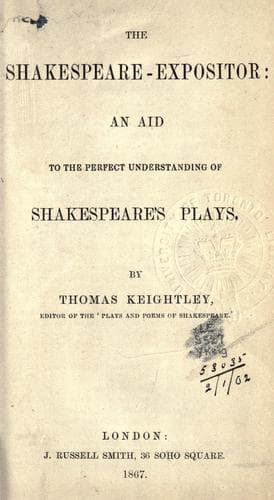
The Shakespeare-Expositor: An Aid to the Perfect Understanding of Shakespeare's PlaysKeightley, Thomas
General
The Shakespeare-Expositor: An Aid to the Perfect Understanding of Shakespeare's Plays
Keightley, Thomas
Drama -- Outlines, syllabi, etc.; Shakespeare, William, 1564-1616 -- Outlines, syllabi, etc.
Here "where" is to be pronounced nearly _wheaa_; for so the English
really do pronounce it, though they may fancy such not to be the case.
Malone, as being an Irishman, seems to have been the first to notice
it. Of these monosyllables there are upwards of thirty in Shakespeare,
and as many in Fletcher; while in the learned Jonson we only meet
with _fire_, _hour_, _our_, _your_, _wear_. In my Edition, and in
this work, I have marked them with a diæresis, as _whëre_, _heär_,
&c. It is rather remarkable that it is almost solely to his higher
characters, such as Hamlet and Coriolanus, that Shakespeare gives this
pronunciation. We also find this dissyllabic pronunciation in such
words as _born_, _morn_, _horn_, &c.
As in French poetry the _e muet_ in words forms a distinct syllable,
_ennemi_, for example, being read as a trisyllable; so we find _angry_,
_entrance_, _children_, _mistress_ (often written _misteris_),
_country_, _witness_, _juggler_, _wondrous_, &c., forming three,
_remembrance_ four syllables. _Captain_ was sometimes _capitain_, as
in French. Many of these cases, we may observe, are mere solutions of
contractions, _angry_, for example, being simply _angery_ contracted.
18.
In opposition to the commonly received theory, I will venture to lay
it down as a fixed principle that the dramatic poets rarely, if ever,
used short lines, except in speeches of a single line, or in the first
or the last line of a speech. This will be apparent to any one who
examines the pages of Jonson and Massinger, who printed their plays
themselves, or those plays of Shakespeare, Fletcher, and others which
are the most correctly printed. Wherever a line of less than five feet
occurs, it will be found to have been produced by omission of words
or by malarrangement of the text. In plays such as Timon, Troilus and
Cressida, or Fletcher's Sea Voyage, of which the original copy was
in bad condition, lines of this kind are of course most numerous. I
may here observe that in this last-named play, the metre of which Mr.
Dyce has pronounced to be "_incurably_ defective," I have, by simple
rearrangement of the text, rendered it as correct as in any other of
Fletcher's plays.
Even in this also Shakespeare took liberties in which his brethren
did not venture to indulge. _He_ began and ended not only speeches,
but paragraphs of speeches, with short lines. Nay, he even made the
concluding short line of one paragraph and the incipient short line of
the next form a single line, thus--
It hath the primal eldest curse upon it:
A brother's murder.--Pray can I not?--Ham. iii. 3.
Of greatest justice.--Write, write, Rinaldo.
All's Well, iii. 4.
Splitted the heart.--This is the sword.
Ant. and Cleop. v. 1.
In the case of final riming couplets the first line may be short, but
_never_ the second.
19.
Public-domain text, read in full here on John Shaqi.
Reviews
Reviews
No reviews yet
Be the first to share your thoughts on this work.
Elsewhere in the archive
Join the Discussion
Join the discussion
Sign in to leave a comment or review.
Sign InorCreate an account