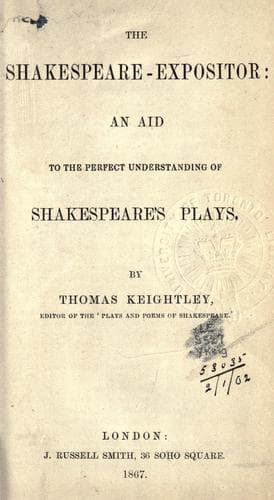
The Shakespeare-Expositor: An Aid to the Perfect Understanding of Shakespeare's PlaysKeightley, Thomas
General
The Shakespeare-Expositor: An Aid to the Perfect Understanding of Shakespeare's Plays
Keightley, Thomas
Drama -- Outlines, syllabi, etc.; Shakespeare, William, 1564-1616 -- Outlines, syllabi, etc.
Rouse up Revenge from ebon den, with fell Alecto's snake.
Ib. v. 5.
A damned death! Let gallows gape for dogs, let man go
free.--Hen. V. iii. 6.
These last six, we may see, all belong to Ancient Pistol. We possibly
might add:
He's ta'en, and, hark! they shout for joy.--
Come down, behold no more.--Jul. Cæs. v. 3.
17.
I will now make a few general observations on the dramatic verse of
Shakespeare and his contemporaries. In the first place, as observed
above, we may lay it down as a general rule that their verse--I may
perhaps include even that of Marston--is never rugged or inharmonious,
but that when it appears to be so it is owing to the copyist or the
printer, or to the fact of the manuscript having been damaged, and not
unfrequently to want of skill in the reader.
An apparent cause of imperfection in lines is the reader's ignorance
of the poet's mode of pronunciation. Thus it was then the custom--one
not quite lost yet--in prose as well as in verse, if two words came
together, one ending, the other beginning, with an accented syllable to
throw back the former accent: hence Shakespeare said, for example, "the
dívine Desdemona." If critics kept this fact in mind, they would not
reject Tieck's excellent emendation of "the précise Angelo" for "the
prenzic Angelo" in Measure for Measure, on account of the accent, when
in the very same play we have "a cómplete bosom," i. 4; "O just, but
sévere law!" ii. 2; "Will bélieve this," _ib._; "Our cómpell'd sins,"
_ib._ 4, &c.; we have actually "précise villains," ii. 1. How would
they read
Might córrupt minds procure knaves as corrupt (Hen. VIII. v. 1)?
In fine, it must be remembered that _ion_, _ien_, and other double
vowels were pronounced dissyllabically, as _oceän_, &c.
Again, neither editors nor readers are in general aware that poets
like Shakespeare, who were born in those parts of England where the
_r_ at the end of words or syllables has the light sound peculiar
to the English language, frequently pronounce as dissyllables those
monosyllables, such as _fire_, _hour_, _more_, _where_, &c., ending in
_r_ after a long vowel or diphthong, as in
I know a bank, where the wild thyme blows.--M. N. D. ii. 1.
Public-domain text, read in full here on John Shaqi.
Reviews
Reviews
No reviews yet
Be the first to share your thoughts on this work.
Elsewhere in the archive
Join the Discussion
Join the discussion
Sign in to leave a comment or review.
Sign InorCreate an account