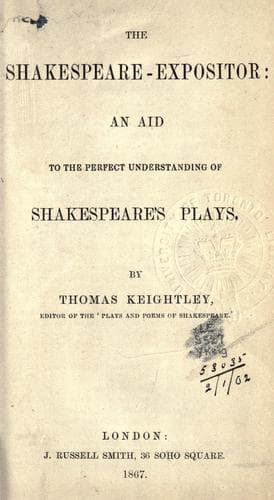
The Shakespeare-Expositor: An Aid to the Perfect Understanding of Shakespeare's PlaysKeightley, Thomas
General
The Shakespeare-Expositor: An Aid to the Perfect Understanding of Shakespeare's Plays
Keightley, Thomas
Drama -- Outlines, syllabi, etc.; Shakespeare, William, 1564-1616 -- Outlines, syllabi, etc.
Beside all those forms of verse, the plays of our old dramatists
contain a large quantity of prose. But it is only prose to the eye;
for it is in reality as metrical as what is printed in separate metric
lines, consisting of lines of five or six feet, each of two or three
syllables, but printed continuously like prose. I therefore denominate
it "_Metric Prose_" as being metric in substance, prose in form, and
as, moreover, it is termed _prose_ both by Chaucer and Shakespeare,
probably from its less elevated character and from its being written
continuously and without rime or alliteration. I am disposed to regard
the former as being its inventor; and perhaps his reason for writing it
continuously may have been merely the wish to save paper. We know, from
M. de Maucroix's letter to Boileau, that the French poet Racan, whose
poems were of course in rime, also wrote them continuously, and, as it
would appear, for the same reason, though paper must have been less
valuable in his time. As, however, the Anglo-Saxon and early English
alliterative verse was written continuously, Chaucer may have been only
following an established mode. It may be remarked that the poetry of
the Hebrew Scriptures is also written and printed continuously.
Surely it is no egotism to state a plain truth! I therefore say that,
as far as I know, I am myself the very first who, for the last century
or more, has discerned the existence of this metric prose. My discovery
was very gradual. I first recognized it in the plays of Beaumont
and Fletcher, and, advancing step by step, I at length arrived at
the certainty that for three centuries and a half, from Chaucer and
Wickliffe to Dryden and Tillotson, almost every work claiming to be
regarded as a literary composition is in this form. Such are histories
from Sir T. More to Clarendon, translations, controversial and
philosophical works, as those of Hooker, Brown, Taylor, and Cudworth,
versions of the Scriptures from Wickliffe to the authorized one
inclusive, sermons, inclusive of those of Barrow, South, and Tillotson,
the Liturgy, except the Creeds, Te Deum, and Catechism, all prefaces,
dedications and letters of compliment, &c. The chief exceptions were
Hall and the other chroniclers, Purchas, Hakluyt, Fuller, Bunyan,
Ludlow, L'Estrange, and Mrs. Hutchinson. The Ecclesiastical Policy,
The Liberty of Prophesying, and The Areopagitica, for example, are
as decidedly metrical as The Paradise Lost, only admitting more
trisyllabic feet, and being printed continuously. Hence, too, in a
great measure, arises the charm which we find in the prose of our old
writers, and of which we have been ignorant of the secret source; as
when Cowper styles Sidney "warbler of poetic prose."
Public-domain text, read in full here on John Shaqi.
Reviews
Reviews
No reviews yet
Be the first to share your thoughts on this work.
Elsewhere in the archive
Join the Discussion
Join the discussion
Sign in to leave a comment or review.
Sign InorCreate an account