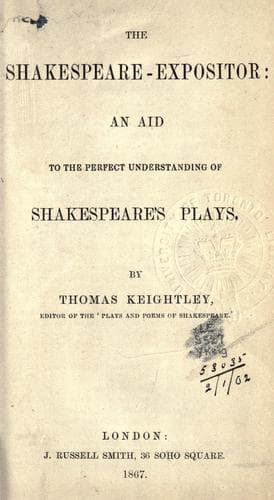
The Shakespeare-Expositor: An Aid to the Perfect Understanding of Shakespeare's PlaysKeightley, Thomas
General
The Shakespeare-Expositor: An Aid to the Perfect Understanding of Shakespeare's Plays
Keightley, Thomas
Drama -- Outlines, syllabi, etc.; Shakespeare, William, 1564-1616 -- Outlines, syllabi, etc.
I do not, however, say that this prose was read as verse, with a slight
elevation of tone at the end of each metric line. It was, I think,
read as prose, as Cowper of course read the Arcadia; but the metre
diffused a secret charm through it, which could be felt even by those
who were ignorant of the cause. How easy, by the way, must this mode of
writing prose have made verse-making to the writers of those days! and
how rapidly that prose could be written is proved by the assertion of
Sir Kenelm Digby, who says that in the space of twenty-four hours he
sent out and bought the Religio Medici, read it through, and wrote his
Observations on it, which fill upwards of seventy printed pages, and
are metrical--a fact almost inconceivable.
The only writer of the last century who, as far as I am aware, used
this metric prose--for we seek it in vain in Addison, Pope, Johnson,
Gibbon, &c.--is the historian Robertson, of which fact Mr. Buckle
seems to have had a dim conception; for he speaks of his "_measured_
style." It is a question where Robertson got it; for he could hardly
have invented it, and I think it must have been in Knox, Spottiswoode,
and the Scottish writers of the two preceding centuries, who all
wrote like their English contemporaries. At the same period, however,
his countryman Macpherson invented a new kind of metric prose for
his 'Poems of Ossian.' Even the present century presents us with an
instance in Mr. Lecky's eloquent 'History of Rationalism,' which is as
metrical as the Areopagitica of Milton. Possibly my own remarks on the
subject in 'Notes and Queries' may have directed his attention to it.
Gascoigne's comedy of The Supposes, performed in 1566, a translation
from the Italian of Ariosto, appears to have been the first play
written in this metric prose; Lyly also, somewhat later, wrote in it
his courtly comedies; and it gradually, combined with blank verse, got
entire possession of the scene. The last, I believe, to use it was
Dryden. Ordinary prose--probably in imitation of the French and Italian
comic drama--seems to have been first used after the Restoration, in
the comedies of Killigrew, Shadwell, Wycherley, Etheridge, Sedley, and
other dramatists of that period.
Public-domain text, read in full here on John Shaqi.
Reviews
Reviews
No reviews yet
Be the first to share your thoughts on this work.
Elsewhere in the archive
Join the Discussion
Join the discussion
Sign in to leave a comment or review.
Sign InorCreate an account