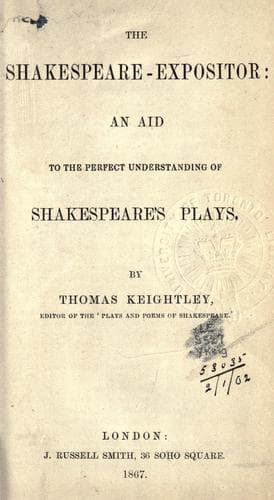
The Shakespeare-Expositor: An Aid to the Perfect Understanding of Shakespeare's PlaysKeightley, Thomas
General
The Shakespeare-Expositor: An Aid to the Perfect Understanding of Shakespeare's Plays
Keightley, Thomas
Drama -- Outlines, syllabi, etc.; Shakespeare, William, 1564-1616 -- Outlines, syllabi, etc.
It is rather remarkable that a union of verse and prose, similar
to this union of regular and irregular verse of our drama, occurs
also in that of India. Sir William Jones tells us, in his preface to
Sacontala, that the Hindoo plays "are all in verse where the dialogue
is elevated, and in prose where it is familiar." Coleridge, who had
not the slightest suspicion of the existence of metre in the dramatic
prose, makes the following just remarks in a note on Fletcher's Custom
of the Country:--"In all comic metres the gulping of short syllables
and the abbreviation of syllables ordinarily long, by the rapid
pronunciation of eagerness and vehemence, are not so much a licence as
a law--a faithful copy of nature." This I think completely justifies
the frequent use of the syncope and synæresis in metric prose.
The same critic again says of Milton's noble conclusion of his treatise
'Of Reformation in England,' "Written in the fervour of his youthful
imagination, in a high poetic strain that wanted metre only to become a
lyrical poem." He felt, but did not see, that the metre actually _was_
there.
The fact of this prose being metric causes us sometimes to doubt
whether a passage should be printed as verse or as prose; and sometimes
what is verse in one edition is prose in another. Thus Mercutio's
celebrated account of Queen Mab, in Romeo and Juliet, which is most
perfect decasyllabic verse, is properly printed as such in the 4to,
1597, while in all the subsequent early editions it is made prose;
and prose it would probably have been at this day had no copy of that
edition remained. On the other hand, most modern editors have most
improperly printed the Nurse's speeches in the preceding scene as
verse, while they are, and rightly, prose in all the original editions.
An editor is, I think, at perfect liberty to use his judgement in this
matter.
The following extracts, in which the termination of each line is
marked, will enable the reader to judge of the truth of my theory. I
must at the same time remind him that such contractions as _I'll_,
_I've_, are rare in these prose scenes, such being left to the
knowledge and skill of the actor or reader.
Public-domain text, read in full here on John Shaqi.
Reviews
Reviews
No reviews yet
Be the first to share your thoughts on this work.
Elsewhere in the archive
Join the Discussion
Join the discussion
Sign in to leave a comment or review.
Sign InorCreate an account