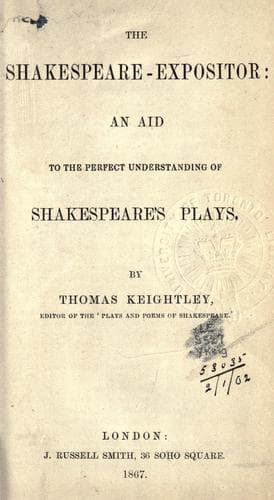
The Shakespeare-Expositor: An Aid to the Perfect Understanding of Shakespeare's PlaysKeightley, Thomas
General
The Shakespeare-Expositor: An Aid to the Perfect Understanding of Shakespeare's Plays
Keightley, Thomas
Drama -- Outlines, syllabi, etc.; Shakespeare, William, 1564-1616 -- Outlines, syllabi, etc.
"Here comes Romeo, here comes Romeo.--Without his roe, | like a
dried herring. O flesh, flesh, how art thou fishified! | Now is
he for the numbers that Petrarch flowed in; | Laura to his lady
was a kitchen-wench; | marry, she had a better love to be-rime
her; | Dido a dowdy; Cleopatra a gypsy; | Helen and Hero hildings
and harlots; Thisby | a grey eye or so, but not to the purpose.
| Signior Romeo, _bon jour_. There's a French salutation | to
your French slop. You gave us the counterfeit | fairly last
night."--Romeo and Juliet, ii. 4.
"Nay, sure, | he's not in hell. He's in Arthur's bosom, if ever |
man went to Arthur's bosom. 'A made a finer end, | and went away
as it had been any christom child. | 'A parted even just between
twelve and one, | even at the turning of the tide. For after I saw
him | fumble with the sheets, and play with flowers, and smile |
upon his finger's end, I knew there was but one way; | for his
nose was as sharp as a pen, and 'a babbled of green fields. | How
now, Sir John! quoth I. What, man! be of good cheer! | So 'a cried
out God, God, God! three or four times. | Now I, to comfort him,
bid him he should not think of God; | I hoped there was no need
to trouble himself | with any such thoughts yet. So 'a bade me
lay | more clothes on his feet. I put my hand into the bed, | and
felt them, and they were as cold as any stone. | Then I felt to
his knees, and so upward and upward, and all was | as cold as any
stone."--King Henry V. ii. 3.
COMEDIES.
COMEDY OF ERRORS.
ACT I.
SC. 1. "Yet that the world may witness that my end
Was wrought by Nature, not by vile offence."
It was surely wrought by _Fortune_ rather than by Nature, and so the
poet may have written it. Collier's folio makes the same correction.
* * * * *
"And by me, had not oür hope been bad."
The editor of 2nd folio read 'me _too_,' not being aware of the
dissyllabic form of 'our.'
* * * * *
"A _poor_ mean woman was delivered."
The editor of 2nd folio added _poor_, which was probably the poet's
word.
* * * * *
"Unwilling I agreed. Alas! too soon
We came aboard * * * * * *
A league from Epidamnum had we sail'd."
We might supply '_our ship. Somewhat more than._'
* * * * *
"Which being violently borne up_on_,
Our helpful ship was splitted in the midst."
It was the mast, not the ship; but the text is probably as the poet
wrote it.
"At length another ship had seiz'd on us."
We should surely read '_the_ other.'
* * * * *
"That by misfortune was my life prolong'd."
It might be better to read _Thus_ for 'That.'
"That his attendant--for his case was like."
Public-domain text, read in full here on John Shaqi.
Reviews
Reviews
No reviews yet
Be the first to share your thoughts on this work.
Elsewhere in the archive
Join the Discussion
Join the discussion
Sign in to leave a comment or review.
Sign InorCreate an account