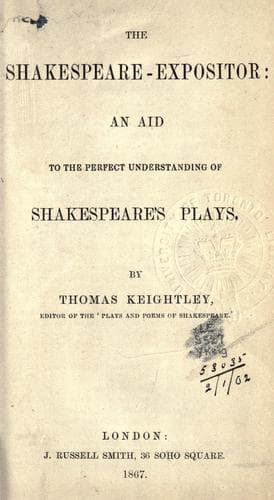
The Shakespeare-Expositor: An Aid to the Perfect Understanding of Shakespeare's PlaysKeightley, Thomas
General
The Shakespeare-Expositor: An Aid to the Perfect Understanding of Shakespeare's Plays
Keightley, Thomas
Drama -- Outlines, syllabi, etc.; Shakespeare, William, 1564-1616 -- Outlines, syllabi, etc.
For 'for,' the judicious correction of 2nd folio, the 1st has
_so_.--See on L. L. L. i. 1; 1 Hen. IV. i. 3.
* * * * *
"To seek thy help by beneficial help."
See Introd. p. 61. For the first 'help,' Pope read _life_; I read
_ransom_, a word already used by the Duke. If the error should be in
the second 'help,' we might, with Malone, read _means_; which, however,
is rather feeble.
* * * * *
"And live, if no thou then art doom'd to die."
For 'no' we should surely, with Rowe, read _not_.
* * * * *
SC. 2. "Who falling there to find his fellow forth."
Mr. Barron Field proposed _failing_, which may be right.
* * * * *
"Methinks your maw, like mine, should be your clock,
And strike you home without a messenger."
'Clock' is Pope's correction for _cook_ of the folio, which, however,
may be right after all; for the cook used to _strike_ on the dresser to
give notice that the dinner was ready.
ACT II.
SC. 1. "Will you come _home_? quoth I."
Hanmer properly added _home_, which was plainly omitted.
* * * * *
"I see the jewel best enamelled
Will lose his beauty, yet the gold bides still,
That others touch.--And often touching will
Where gold; and no man that hath a name
By falsehood and corruption doth it shame."
To give sense to this passage I read in the second line _bide_; in the
fourth, with Warburton, _wear_, with Heath _so a_ for 'no'; in which
two I had thus been anticipated. The punctuation given here is my own.
I am dubious of 'others' in the third line, for which we might read
_fingers_, or some other word.
* * * * *
SC. 2. "Your sauciness will jest upon."
For 'jest' Mr. Dyce reads _jet_, referring to Rich. III. ii. 4, Tit.
Andron. ii. 1; and "It is hard when Englishmen's patience must be thus
_jetted_ upon by strangers."--Play of Sir T. More, p. 2.
* * * * *
"And what he hath scanted them in hair he hath given them in wit."
For the first 'them' Theobald properly read _men_.
* * * * *
"The one to save the money that he spends in trying."
For 'trying' Pope read _tyring_ by simply transposing, Rowe _trimming_.
I rather prefer the former, as _tyring_ is attiring, and 'attire' is
head-dress; but whether used of a man or not I am not certain.--See my
note on Milton's On Time, _v._ 21.
* * * * *
"I live distain'd, thou undishonoured."
Public-domain text, read in full here on John Shaqi.
Reviews
Reviews
No reviews yet
Be the first to share your thoughts on this work.
Elsewhere in the archive
Join the Discussion
Join the discussion
Sign in to leave a comment or review.
Sign InorCreate an account