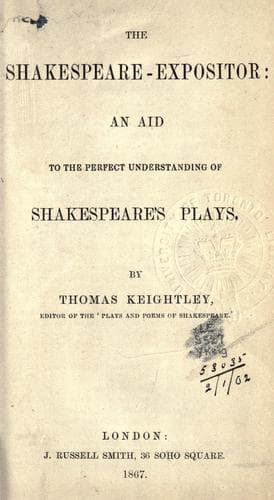
The Shakespeare-Expositor: An Aid to the Perfect Understanding of Shakespeare's PlaysKeightley, Thomas
General
The Shakespeare-Expositor: An Aid to the Perfect Understanding of Shakespeare's Plays
Keightley, Thomas
Drama -- Outlines, syllabi, etc.; Shakespeare, William, 1564-1616 -- Outlines, syllabi, etc.
_Unto_ or _upon_ would seem more correct; but no change is needed.
ACT II.
SC. 1. "Let higher Italy," etc.
This passage has never been understood, yet it is perhaps plain enough.
By 'higher Italy' is meant the part more distant from France. "Will you
travel higher [_i.e._ go further south], or return again to France,"
iv. 3. In this place it is Tuscany that is termed 'higher Italy.' "But
then _up farther_, and as far as Rome," Tam. of Shrew, iv. 2, where
the speaker is at Padua. By 'bated' is meant abated, subdued, as we
_abate_ a nuisance; 'inherit' is, as usual, possess; and 'the fall of
the last monarchy' is the fallen final state of the Roman Empire, the
last monarchy according to the current interpretation of the Book of
Daniel. "The antique ruins of _the Roman Fall_."--F. Q. i. 549. "The
underseated deities that circle Saturn's fall."--Chap. II. xv. 208.
"Redeem'd him from his fall and made him mine."--Fletch. Kt. of Burn.
Pest. iv. 3. But perhaps we should read _pall_, as being still more
contemptuous, indicating that the symbol only and not the real power
had been inherited. By 'Those,' etc., I think are meant the Ghibelines
or Imperial party, to which Siena belonged, while Florence was usually
Guelf, the side which was always taken by France, out of opposition
to the German Emperor. There is, however, no mention of Guelfs or
Ghibelines either in the story in the Decamerone or in the Palace of
Pleasure; so that Shakespeare must have gotten his knowledge elsewhere,
which is to me one proof, among many, of the extent of his reading. I
regard this as the only explanation that gives sense to the passage.
* * * * *
"And lustrous, _in_ a word good metals."
* * * * *
"With his cicatrice, an emblem of war,"
The folio reads 'his cicatrice with.' As usual, Theobald made the
correction.
* * * * *
"Pardon, my lord, for me and for my tidings.--
I'll see thee to stand up," etc.
This is the arrangement of the folio, which Malone altered needlessly.
For 'see' Theobald read _fee_, and in the next line _bought_ for
'brought.' These corrections most editors have adopted, but I see no
great gain in them. I confess I do not clearly discern the meaning
here of either 'see' or _fee_; and Mr. Staunton's _sue_ is not much
better, and I suspect that the poet's word may have been a different
one, which I think I can fix on with something like certainty. He wrote
then 'I _beseech_ thee,' but _ch_ being either blotted or rubbed out,
the transcriber or printer read _I be_ 'Ile,' the usual form of _I'll_.
In Ham. iii. 4, and Tim. i. 2, we have a similar effacement of two
letters. "Pardon, my lord.--I pray you all, stand up" (M. N. D. iv. 1),
is exactly parallel. See also Hen. VIII. v. 1.
* * * * *
"Quicken a rock, and make you dance canary."
Public-domain text, read in full here on John Shaqi.
Reviews
Reviews
No reviews yet
Be the first to share your thoughts on this work.
Elsewhere in the archive
Join the Discussion
Join the discussion
Sign in to leave a comment or review.
Sign InorCreate an account