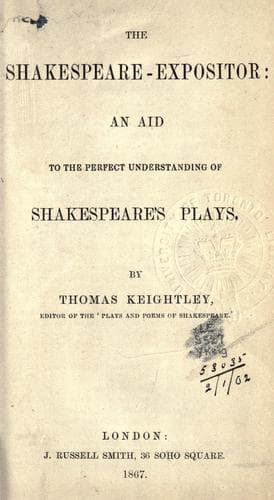
The Shakespeare-Expositor: An Aid to the Perfect Understanding of Shakespeare's PlaysKeightley, Thomas
General
The Shakespeare-Expositor: An Aid to the Perfect Understanding of Shakespeare's Plays
Keightley, Thomas
Drama -- Outlines, syllabi, etc.; Shakespeare, William, 1564-1616 -- Outlines, syllabi, etc.
In the original tale she expressly excepts the _children_ and relatives
of the King.
* * * * *
SC. 2. "An end, sir, to your business. Give Helen this."
For 'An end' I feel almost certain we should read _Attend_, or possibly
_And now_. I have, however, made no change in the text of my Edition.
Some point 'An end, sir: to your business.'
* * * * *
SC. 3. "_Mort de vinaigre!_ is not that Helen_a_?"
* * * * *
"And writ as little beard."
For 'writ' we should, I think, read _wore_ or _with_. Mr. Dyce,
however, says it was "the phraseology of Shakespeare's time." He
should, then, have given us examples of it; for _write man_ and such
like are not such. Perhaps this and the following speeches of Lafeu
should be _Asides_.
* * * * *
"Do they all deny her? An they were sons of mine," etc.
The folio reads, "Do all they."
* * * * *
"From lowest place, whence virtuous things proceed."
So the folio reads and punctuates. The context shows that we should
read _when_, with Thirlby. Two lines further on we have 'additions
swell's,' which, reading 'swells,' is grammatically right; but the 2nd
folio read '_addition_,' and Malone, who is usually followed, _swell_.
* * * * *
"Where dust and damn'd oblivion is the tomb."
For 'damn'd' we might feel inclined to read _dim_, _damp_, or _dank_.
"And in a dark and _dankish_ vault," Com. of Err. v. 1; or (as in Tr.
and Cr. iii. 2) _blind_. The text, however, is probably right, for
'damn'd' often merely meant what is odious, or hateful, was to be
condemned or simply was reprehensible. "Surfeits, impostumes, grief,
and _damn'd_ despair."--Ven. and Adon. (See on Othel. i. 1.)
* * * * *
"My honour's at the stake, which to defeat."
I have read, with Theobald, _defend_. Farmer's explanation of 'defeat'
is untenable.
* * * * *
"Whose ceremony
Shall seem expedient on the now borne brief,
And be perform'd to-night."
By 'brief' I would understand the marriage-contract; for _brief_ is
used with great latitude. So in v. 3 we have "a sweet verbal _brief_,"
_i.e._ commission or address. The 'now borne' of the folio is, I think,
_now-born_, _i.e._ which has just come into being, been made. Possibly
we might read _new-born_, like "things _new-born_" (W. T. iii. 3),
"_new-born_ gauds" (Tr. and Cr. iii. 3). We have _now_ for _new_ (M. N.
D. i. 1). I read _come_ for 'seem.' (See on Macb. i. 2.)
* * * * *
"Than the commission of your birth and virtue give you heraldry for."
Hanmer transposed 'commission' and 'heraldry'; and most editors have
followed him. They seem to be right, and I agree with them.
* * * * *
"What, what, _what_, sweetheart?"
Public-domain text, read in full here on John Shaqi.
Reviews
Reviews
No reviews yet
Be the first to share your thoughts on this work.
Elsewhere in the archive
Join the Discussion
Join the discussion
Sign in to leave a comment or review.
Sign InorCreate an account