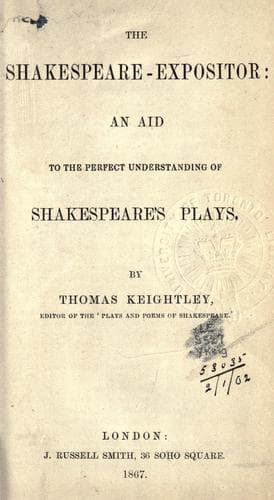
The Shakespeare-Expositor: An Aid to the Perfect Understanding of Shakespeare's PlaysKeightley, Thomas
General
The Shakespeare-Expositor: An Aid to the Perfect Understanding of Shakespeare's Plays
Keightley, Thomas
Drama -- Outlines, syllabi, etc.; Shakespeare, William, 1564-1616 -- Outlines, syllabi, etc.
SC. 2. "As you are now, for you are cold and stern."
Collier's folio reads _as stone_ for 'and stern,' which is very
plausible.
"Who, moving others, are themselves _as stone_
Unmoved, cold, and to temptation slow."--Son. xciv.
* * * * *
"To swear by him whom I profess to love,
That I will work against him."
I read _to_ for 'by,' in which I had been anticipated by Johnson,
who was followed by Malone. 'Swear' naturally suggested 'by' to the
printer's mind. (See on Macb. i. 5, R. and J. i. 1.)
"For what's more monstrous, more a prodigy,
Than to hear me protest truth of affection
Unto a person that I would dishonour?"
Jonson, New Inn, iii. 2.
The same sentiment is expressed in "Yes, as I love the woman that
wrong'd him" (Meas. for Meas. ii. 3). In this speech of Diana's, Mr.
Staunton would give 'Then pray you ... love you ill' to Bertram; but
without any great advantage.
* * * * *
"I see that men make ropes in such a scarre,
That we'll forsake ourselves."
This is evident nonsense. Rowe read _hopes_ and _affairs_ for 'ropes'
and 'scarre'; and to this emendation, or Mitford's of _case_ for
'scarre,' I see no very serious objection. We have "make envy" (Hen.
VIII. v. 2), "make doubt" (_Ib._), "make comfort" (Cymb. i. 2), "making
practice" (Meas. for Meas. iii. 2). Why then object to "make hopes?"
even though it is to be found nowhere else in Shakespeare. 'Scarre,'
however, is probably right; in Lingua (i. 6) we have, "Poets will write
whole volumes of this _scar_." It must be remembered that _scare_ was
written _scarre_, and so as a substantive 'scarre' may be fright,
alarm, flutter, perturbation. Finally, it is even possible that 'ropes'
may be right, a line being lost; something of this sort: "_Of oaths and
vows to scale our fort, in hope._"
* * * * *
"Have the like oaths. He had sworn to marry me."
Here, as elsewhere, we have _has_ and _had_ confounded.
* * * * *
SC. 3. "Merely our traitors, and, as in the common course of all
treasons, we still see them reveal themselves, till they
attain to their abhorred ends."
I think it would be better to read, as I have done, _is_ for 'in' (see
on King John, iv. 2), and _conceal_ for 'reveal,' unless for the latter
we should prefer reading _veil_. Perhaps also we might retain 'reveal,'
and read _when_ for 'till.'
* * * * *
"Is it not meant damnable in us to be trumpeters of our unlawful
intents?"
Malone's first thought was _most_ for 'meant.' Mr. Dyce proposes _mean
and_; I think he is right, and have followed him. (See on Rom. and Jul.
i. 3.)
* * * * *
"If I were to live this present hour."
Public-domain text, read in full here on John Shaqi.
Reviews
Reviews
No reviews yet
Be the first to share your thoughts on this work.
Elsewhere in the archive
Join the Discussion
Join the discussion
Sign in to leave a comment or review.
Sign InorCreate an account