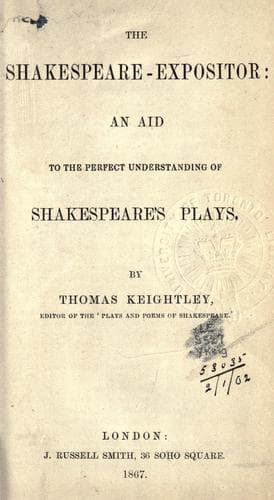
The Shakespeare-Expositor: An Aid to the Perfect Understanding of Shakespeare's PlaysKeightley, Thomas
General
The Shakespeare-Expositor: An Aid to the Perfect Understanding of Shakespeare's Plays
Keightley, Thomas
Drama -- Outlines, syllabi, etc.; Shakespeare, William, 1564-1616 -- Outlines, syllabi, etc.
The context seems to require _die_, not 'live'; so here, as elsewhere,
we may happen to have a substitution of the contrary term. (See Introd.
p. 66.)
* * * * *
"Or whether he thinks it were not possible."
This would seem to be one of the places where 'or' is for _and_.
* * * * *
SC. 4. "Dear almost as his life; _for_ which gratitude."
Both sense and metre require this addition.
* * * * *
"Our wagon is prepared, and time revives us."
As 'revives' seems to make no sense, we might read _reproves_, or
rather _invites_. "The _time invites you_. Go." (Ham. i. 3.)
* * * * *
SC. 5. "But sure he is the prince of the world."
For 'sure' we should, I think, read _since_.
ACT V.
SC. 2. "But I am now, sir, muddied in Fortune's mood."
Warburton's conjecture of _moat_ for 'mood' is very specious, but,
I fear, nothing more. 'Muddied' and 'mood' form what is termed a
paronomasia.
* * * * *
"I do pity his distress in my smiles of comfort."
The Cambridge editors adopt Warburton's reading _similes_. I doubt if
either was the poet's word.
* * * * *
"You beg more than _one_ word then."
It was the 3rd folio that supplied _one_.
* * * * *
SC. 3. "Natural rebellion done in the blade of youth,
When oil and fire," etc.
The context would suggest _blaze_ to any one, as it did to Theobald.
* * * * *
"The nature of his great offence is dead."
He means Helena, but I do not see how 'nature' applies to her. Perhaps
we should read _motive_; or some other word.
* * * * *
"I am not a day of season."
Something seems evidently lost here; for the address to Bertram is
too abrupt. I would read 'season_able weather_.' We have, 'Like an
_unseasonable_ stormy day (Rich. II. iii. 2); and there was in the
Liturgy, at that time, "a prayer for _seasonable weather_." The phrase
'day of season,' I believe, occurs nowhere else. Lower down--probably
in the same page of the MS.--there appears to be an effacement of the
same kind, and the loss of an entire line.
* * * * *
"The daughter of this lord.--
Admiringly, my liege. At first * * * _sight of her_. (?)
I stuck my choice upon her. Ere my heart
Durst make too bold a herald of my tongue,
Where the impression of mine eye infixing," etc.
Is it not amazing that no one seems ever to have perceived that a line
must have been lost between the last two lines? It may have been of
this kind, "_Another object met my wandering fancy_." Capell, I find,
read 'At _the_ first _sight_.'
* * * * *
"The last that ere I took her leave at court."
Public-domain text, read in full here on John Shaqi.
Reviews
Reviews
No reviews yet
Be the first to share your thoughts on this work.
Elsewhere in the archive
Join the Discussion
Join the discussion
Sign in to leave a comment or review.
Sign InorCreate an account