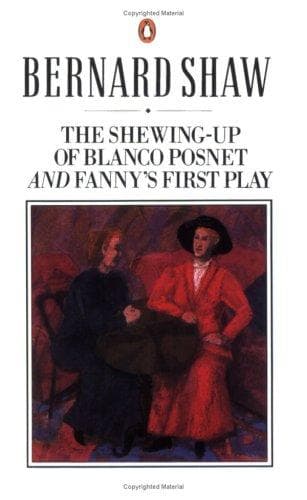
Censorship; Horse stealing -- Drama; West (U.S.) -- Drama
Whatever is contrary to established manners and customs is immoral.
An immoral act or doctrine is not necessarily a sinful one: on the
contrary, every advance in thought and conduct is by definition immoral
until it has converted the majority. For this reason it is of the
most enormous importance that immorality should be protected jealously
against the attacks of those who have no standard except the standard of
custom, and who regard any attack on custom--that is, on morals--as an
attack on society, on religion, and on virtue.
A censor is never intentionally a protector of immorality. He always
aims at the protection of morality. Now morality is extremely valuable
to society. It imposes conventional conduct on the great mass of persons
who are incapable of original ethical judgment, and who would be
quite lost if they were not in leading-strings devised by lawgivers,
philosophers, prophets and poets for their guidance. But morality is
not dependent on censorship for protection. It is already powerfully
fortified by the magistracy and the whole body of law. Blasphemy,
indecency, libel, treason, sedition, obscenity, profanity, and all the
other evils which a censorship is supposed to avert, are punishable
by the civil magistrate with all the severity of vehement prejudice.
Morality has not only every engine that lawgivers can devise in full
operation for its protection, but also that enormous weight of public
opinion enforced by social ostracism which is stronger than all the
statutes. A censor pretending to protect morality is like a child
pushing the cushions of a railway carriage to give itself the sensation
of making the train travel at sixty miles an hour. It is immorality, not
morality, that needs protection: it is morality, not immorality, that
needs restraint; for morality, with all the dead weight of human inertia
and superstition to hang on the back of the pioneer, and all the malice
of vulgarity and prejudice to threaten him, is responsible for many
persecutions and many martyrdoms.
Public-domain text, read in full here on John Shaqi.
Reviews
Reviews
No reviews yet
Be the first to share your thoughts on this work.
Join the Discussion
Join the discussion
Sign in to leave a comment or review.
Sign InorCreate an account