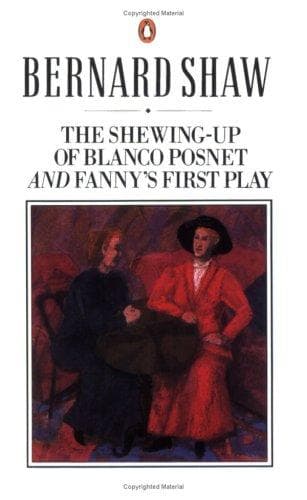
Censorship; Horse stealing -- Drama; West (U.S.) -- Drama
It was pointed out by Charles Dickens in Little Dorrit, which remains
the most accurate and penetrating study of the genteel littleness of
our class governments in the English language, that whenever an abuse
becomes oppressive enough to persuade our party parliamentarians
that something must be done, they immediately set to work to face
the situation and discover How Not To Do It. Since Dickens's day
the exposures effected by the Socialists have so shattered the
self-satisfaction of modern commercial civilization that it is no longer
difficult to convince our governments that something must be done,
even to the extent of attempts at a reconstruction of civilization on
a thoroughly uncommercial basis. Consequently, the first part of the
process described by Dickens: that in which the reformers were snubbed
by front bench demonstrations that the administrative departments were
consuming miles of red tape in the correctest forms of activity, and
that everything was for the best in the best of all possible worlds,
is out of fashion; and we are in that other phase, familiarized by the
history of the French Revolution, in which the primary assumption is
that the country is in danger, and that the first duty of all parties,
politicians, and governments is to save it. But as the effect of this
is to give governments a great many more things to do, it also gives a
powerful stimulus to the art of How Not To Do Them: that is to say, the
art of contriving methods of reform which will leave matters exactly as
they are.
The report of the Joint Select Committee is a capital illustration of
this tendency. The case against the censorship was overwhelming; and the
defence was more damaging to it than no defence at all could have
been. Even had this not been so, the mere caprice of opinion had turned
against the institution; and a reform was expected, evidence or no
evidence. Therefore the Committee was unanimous as to the necessity of
reforming the censorship; only, unfortunately, the majority attached
to this unanimity the usual condition that nothing should be done to
disturb the existing state of things. How this was effected may be
gathered from the recommendations finally agreed on, which are as
follows.
1. The drama is to be set entirely free by the abolition of the existing
obligation to procure a licence from the Censor before performing a
play; but every theatre lease is in future to be construed as if it
contained a clause giving the landlord power to break it and evict the
lessee if he produces a play without first obtaining the usual licence
from the Lord Chamberlain.
Public-domain text, read in full here on John Shaqi.
Reviews
Reviews
No reviews yet
Be the first to share your thoughts on this work.
Join the Discussion
Join the discussion
Sign in to leave a comment or review.
Sign InorCreate an account