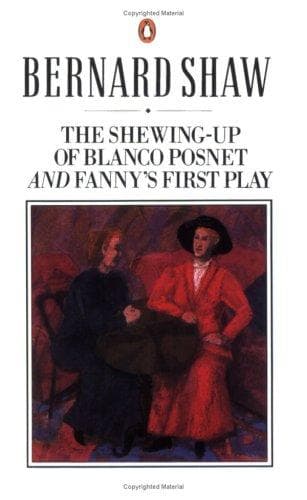
Censorship; Horse stealing -- Drama; West (U.S.) -- Drama
sole excuse for the Act of 1843 and for the denial to the theatre of
the liberties secured, at far greater social risk, to the press and the
platform.
There is no question here of giving the theatre any larger liberties
than the press and the platform, or of claiming larger powers for
Shakespear to eulogize Brutus than Lord Rosebery has to eulogize
Cromwell. The abolition of the censorship does not involve the abolition
of the magistrate and of the whole civil and criminal code. On the
contrary it would make the theatre more effectually subject to them
than it is at present; for once a play now runs the gauntlet of the
censorship, it is practically placed above the law. It is almost
humiliating to have to demonstrate the essential difference between a
censor and a magistrate or a sanitary inspector; but it is impossible
to ignore the carelessness with which even distinguished critics of
the theatre assume that all the arguments proper to the support of a
magistracy and body of jurisprudence apply equally to a censorship.
A magistrate has laws to administer: a censor has nothing but his own
opinion. A judge leaves the question of guilt to the jury: the Censor
is jury and judge as well as lawgiver. A magistrate may be strongly
prejudiced against an atheist or an anti-vaccinator, just as a sanitary
inspector may have formed a careful opinion that drains are less healthy
than cesspools; but the magistrate must allow the atheist to affirm
instead of to swear, and must grant the anti-vaccinator an exemption
certificate, when their demands are lawfully made; and in cities the
inspector must compel the builder to make drains and must prosecute
him if he makes cesspools. The law may be only the intolerance of the
community; but it is a defined and limited intolerance. The limitation
is sometimes carried so far that a judge cannot inflict the penalty for
housebreaking on a burglar who can prove that he found the door open
and therefore made only an unlawful entry. On the other hand, it is
sometimes so vague, as for example in the case of the American law
against obscenity, that it makes the magistrate virtually a censor. But
in the main a citizen can ascertain what he may do and what he may not
do; and, though no one knows better than a magistrate that a single
ill-conducted family may demoralize a whole street, no magistrate can
imprison or otherwise restrain its members on the ground that their
immorality may corrupt their neighbors. He can prevent any citizen
from carrying certain specified weapons, but not from handling pokers,
table-knives, bricks or bottles of corrosive fluid, on the ground that
he might use them to commit murder or inflict malicious injury. He has
no general power to prevent citizens from selling unhealthy or poisonous
substances, or judging for themselves what substances are unhealthy and
what wholesome, what poisonous and what innocuous: what he CAN do is
to prevent anybody who has not a specific qualification from selling
Public-domain text, read in full here on John Shaqi.
Reviews
Reviews
No reviews yet
Be the first to share your thoughts on this work.
Join the Discussion
Join the discussion
Sign in to leave a comment or review.
Sign InorCreate an account