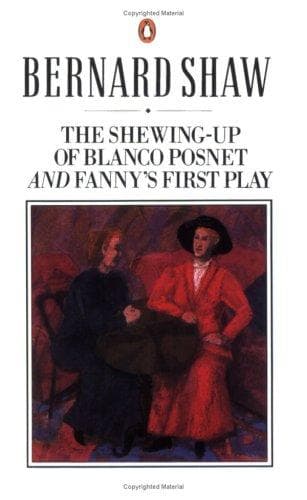
Censorship; Horse stealing -- Drama; West (U.S.) -- Drama
It has been suggested that the present censorship should be supplemented
by a board of experts, who should deal, not with the whole mass of plays
sent up for license, but only those which the Examiner of Plays refuses
to pass. As the number of plays which the Examiner refuses to pass is
never great enough to occupy a Board in permanent session with regular
salaries, and as casual employment is not compatible with public
responsibility, this proposal would work out in practice as an addition
to the duties of some existing functionary. A Secretary of State would
be objectionable as likely to be biased politically. An ecclesiastical
referee might be biassed against the theatre altogether. A judge in
chambers would be the proper authority. This plan would combine the
inevitable intolerance of an enlightened censorship with the popular
laxity of the Lord Chamberlain.
The judge would suppress the pioneers, whilst the Examiner of Plays
issued two guinea certificates for the vulgar and vicious plays. For
this reason the plan would no doubt be popular; but it would be very
much as a relaxation of the administration of the Public Health Acts
accompanied by the cheapening of gin would be popular.
THE ARBITRATION PROPOSAL
On the occasion of a recent deputation of playwrights to the Prime
Minister it was suggested that if a censorship be inevitable, provision
should be made for an appeal from the Lord Chamberlain in cases of
refusal of licence. The authors of this suggestion propose that the
Lord Chamberlain shall choose one umpire and the author another. The two
umpires shall then elect a referee, whose decision shall be final.
This proposal is not likely to be entertained by constitutional lawyers.
It is a naive offer to accept the method of arbitration in what is
essentially a matter, not between one private individual or body and
another, but between a public offender and the State. It will
presumably be ruled out as a proposal to refer a case of manslaughter
to arbitration would be ruled out. But even if it were constitutionally
sound, it bears all the marks of that practical inexperience which leads
men to believe that arbitration either costs nothing or is at least
cheaper than law. Who is to pay for the time of the three arbitrators,
presumably men of high professional standing? The author may not be
able: the manager may not be willing: neither of them should be called
upon to pay for a public service otherwise than by their contributions
to the revenue. Clearly the State should pay. But even so, the
difficulties are only beginning. A licence is seldom refused except on
grounds which are controversial.
Public-domain text, read in full here on John Shaqi.
Reviews
Reviews
No reviews yet
Be the first to share your thoughts on this work.
Join the Discussion
Join the discussion
Sign in to leave a comment or review.
Sign InorCreate an account