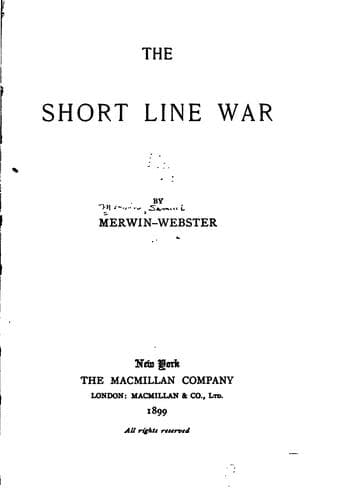
Historical fiction; Railroads -- History -- Fiction
“Don't you see? If he had seen Weeks early enough they might have upset
me. He must be an awful fool.”
Katherine followed him to the elevator with a peculiar expression. She
wondered why her father's remark annoyed her.
Before leaving Manchester Mr. McNally wired to the Tillman City Finance
Committee an invitation to dine at the Hotel Tremain at 7.45 P.M. During
the journey he matured his plan of campaign.
This was not likely to be more than mildly exciting, for twenty years
of political and financial juggling had fitted Mr. McNally for delicate
work. In his connection with various corporations he had learned the art
of subduing insubordinate legislatures without friction, if not without
expense, and naturally the present task offered few difficulties. That
was why, after an hour or so of thought, he straightened up in his seat,
bought a paper, and read it with interest, from the foreign news to the
foot-ball prospects. Mr. McNally's tastes were cosmopolitan, and now
that his method was determined he dismissed M. & T. stock from his mind.
He knew Tillman City, and more to the point, he knew Michael Blaney,
Chairman of the Council Finance Committee. Finesse would not be needed,
subtlety would be lost, with Blaney, and so Mr. McNally was prepared to
talk bluntly. And on occasion Mr. McNally could be terseness itself.
On his arrival he took a cab for the hotel. The Committee were on hand
to meet him, and Blaney made him acquainted with the others.
Michael Blaney was a man of the people. He was tall and angular, hands
and face seamed and leathery from the work of earlier days, eyes small
and keen, and a scraggy mustache, that petered out at the ends. He had
risen by slow but sure stages from a struggling contractor with no pull,
to be the absolute monarch of six wards; and as the other seven wards
were divided between the pro- and anti-pavers, Blaney held the municipal
reins. He still derived an income from city contracts, but his name did
not appear on the bids.
After dinner Mr. McNally led the way to his room, and in a few words
announced that he had come for the M. & T. stock. Blaney tipped back in
his chair and shook his head.
“Can't do it, Mr. McNally. It ain't for sale.”
“So I heard,” said McNally, quietly, “but I want it.”
“You see it's like this. When they were building the line, we took the
stock on a special act--”
“I understand all that,” McNally interrupted. “That can be fixed.”
Williams, one of the other two, leaned over the table.
“We ain't fools enough to go up against Jim Weeks,” he said.
“Don't worry about Weeks,” replied McNally, “I can take care of him.”
“Who are you buying for?” asked Blaney.
McNally looked thoughtfully at the three men, then said quietly:--
“I am buying for C. & S.C. Jim Weeks is all right, but he can't hold out
against us.”
“Well, I tell you, Mr. McNally, we can't sell.”
“Why not?”
“Outside of the original terms--and they sew us up--we never could get
it through the Council.”
Public-domain text, read in full here on John Shaqi.
Reviews
Reviews
No reviews yet
Be the first to share your thoughts on this work.
Join the Discussion
Join the discussion
Sign in to leave a comment or review.
Sign InorCreate an account