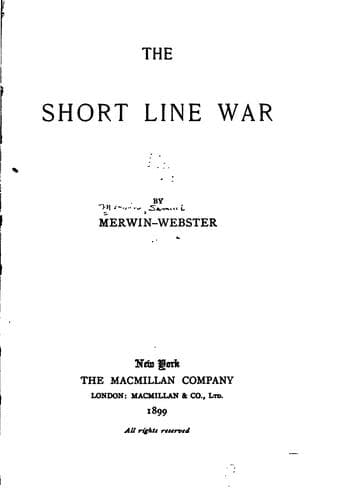
Historical fiction; Railroads -- History -- Fiction
“Good night, Blaney; good night, boys.” McNally shook hands cordially
with each. “We'll have a good road here yet.”
When their footfalls died away in the hall, Mr. McNally turned to the
table, gathered the cards, and replaced them in his bag. The room
was close with cigar smoke, and he threw open the windows. With the
sensation of removing something offensive, he washed his hands. He stood
for a few moments looking out the window at the quiet city, then he
sauntered downstairs and into the deserted parlor, seating himself at
the piano. His plump hands wandered over the keys with surprisingly
delicate touch. For a short time he improvised. Then as the night quiet
stole into his thoughts, he drifted into Rubinstein's Melody in F,
playing it dreamily.
CHAPTER IV
JIM WEEKS CLOSES IN
It was midnight when Jim Weeks reached Tillman City. The next morning
at breakfast he recognized Mr. McNally, and though he nodded pleasantly,
his thoughts were not the most amicable. He knew that McNally meant
mischief, and he also knew that McNally's mischief could be accomplished
only through one man, Michael Blaney. Heretofore Blaney had not troubled
Jim. Jim's power and his hold on Tillman City affairs had combined to
inspire the lesser dictator with awe, and in order to obtain concessions
it had been necessary only to ask for them. Jim never dealt direct with
Blaney. The councilman to whom he intrusted his measures was
Bridge, leader of the pro-pavers. Jim had won him by generosity in
transportation of paving supplies. But when Jim left the hotel that
morning he wasted no time on minority leaders. Bridge was useful to
prepare and introduce ordinances, but was not of the caliber for big
deals, so Jim ordered a carriage and drove direct to Blaney's house.
Although the hour was early, the politician was not at home. His wife,
a frail little woman, came to the door and extended a flexible speaking
trumpet that hung about her shoulders.
“No,” she said in reply to Jim's question, “he's down on the artesian
road watching a job. He won't be back till noon.”
The road in question leads from the city to the artesian well a few
miles away. Jim turned his horses and went back through the town and out
toward the country. He found Blaney just inside the city limits, sitting
on a curb and overseeing two bosses and a gang of laborers, who were
tearing up the macadam with the destructive enthusiasm of the hired
sewer digger.
“How are you, Blaney?” called Jim, pulling up.
Public-domain text, read in full here on John Shaqi.
Reviews
Reviews
No reviews yet
Be the first to share your thoughts on this work.
Join the Discussion
Join the discussion
Sign in to leave a comment or review.
Sign InorCreate an account