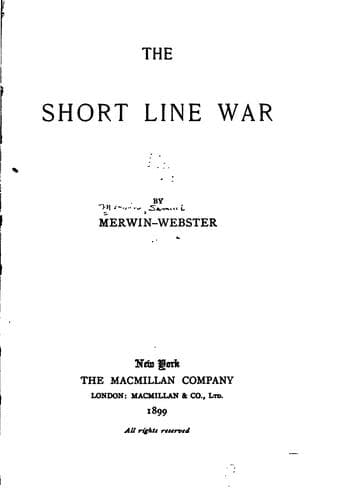
Historical fiction; Railroads -- History -- Fiction
“Maybe he'll try. But I'll have five hundred men with guns in his way.
I'll tell you, West, I'm not going to give in. I never have yet.”
“No,” said Harvey, thoughtfully, “I don't believe you have.” And he
added, “I saw Porter to-night.”
“Where?”
“Up at the Bismarck. McNally was with him.”
“Anybody else?”
“His daughter.”
“Pretty girl, I hear.”
“Yes,”--Harvey spoke slowly,--“she is. A very pretty girl. Her father
seems to be a gentleman.”
“Oh, Porter's all right. He's doing what 'most any man in his place
would do. It's business. There's nothing personal in it.”
“I suppose not,” Harvey replied. “It's still a little odd to me. I'm
afraid I'd want to break his head.”
Jim laughed.
“You'll get over that. I reckon you haven't got anything against his
daughter.”
“Perhaps not,” said Harvey; “but that's different.”
“Oh, is it?”
Harvey sat for a moment without reply, then he tossed his half-smoked
cigar into the ashtray and rose.
“Don't go, West. I shall be up for a long while.”
“I'm tired,” Harvey replied. “I need sleep. Good night.”
Harvey walked home slowly. Once in his room, he did not light up;
instead he drew an easy-chair to the window and stretched out where he
could feel the breeze. It had been a strange evening. He went back over
the conversation in the Bismarck. Katherine had seemed even prettier
than usual; but before every picture of her rose the calm, smiling face
of McNally--McNally with his pudgy hands and his cool blue eyes, his
ease and his well-placed comment. Harvey rested an elbow on the sill and
looked out the window. The crowds were gone now. No sound came save the
rustle of the leaves and the occasional rumble of the elevated trains.
The moon was clouded, but over the trees the stars were out, as clear
and soft as on other evenings that had not seemed so dreary. He turned
away and walked over to the mantel, where Katherine's picture leaned
against the wall. He found it without striking a light, and brought it
to the window. By the dim light from the street and the sky, he could
see her face in faint outline.
“Well, Miss Katherine,” he said, looking into the shadowy eyes, “I guess
Jim Weeks isn't the only fighter here.”
CHAPTER VI
JUDGE BLACK
There are two kinds of business men: those who make their business at
once work and play, a means of acquiring wealth and a most exciting
game whose charms make all other games seem flat and unprofitable; and
another class who, though they may enjoy work, turn for recreation to
whist or philanthropy or golf. Porter belonged to the latter class. He
went into the fight against Jim Weeks simply because he hoped it would
make him richer, and it did not occur to him that he could enjoy the
action. On Wednesday morning he sat in his office wondering if he could
not get away to the Truesdale golf links for a match that afternoon.
Public-domain text, read in full here on John Shaqi.
Reviews
Reviews
No reviews yet
Be the first to share your thoughts on this work.
Join the Discussion
Join the discussion
Sign in to leave a comment or review.
Sign InorCreate an account