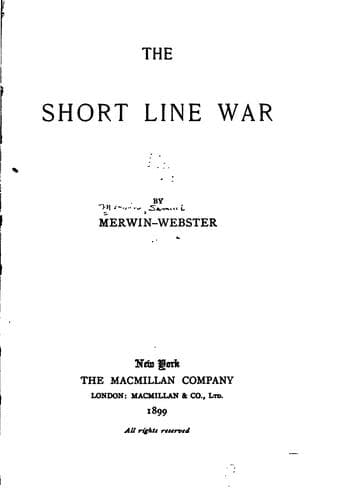
Historical fiction; Railroads -- History -- Fiction
Furthermore it was obvious to the men in 33 that he meant to keep on
coming, and as none of them had any wish to try conclusions, even with
little No. 10, the big locomotive stopped short and went backing down
the track, the deputies shouting to their comrades at the station for
reenforcements.
No. 10 slowed down as she backed on to the main track, and as Murphy
threw the switch she stopped and then moved forward. Stevens waited for
Murphy, who left the switch open and climbed into the cab. Then with a
clear track before her No. 10 went tearing down the long grade as fast
as her dumpy little drivers would carry her.
Halfway to Byron is a milk shed with a short siding, and when they
reached it Stevens shut down and stopped with a jerk.
“Get out,” he said to Murphy, “and throw over that switch and put out
the lamp.”
As they started on again he said dryly, “When they strike that, it may
teach 'em to go slow for the rest of the run.”
It was just six-seventeen by the station clock when Mason, the operator
at Byron, heard No. 10 coming in. He ran out on the platform, but
Stevens waved him back.
“Get in there,” he said as he dropped from the cab. “I want you to send
a message quick.”
CHAPTER XIV
A CAPTURE AT BRUSHINGHAM
On the same Wednesday morning Jawn Donohue was oiling the old switch
engine preparatory to making up a train of coal cars. Since his ride
with the President, Jawn had been even more silent than before. His
work had been done with the same gruff independence, and his fireman had
received the usual quota of stern rebukes; in fact, Jawn was outwardly
so like his old self that none suspected him of emotion, but Jawn knew
how thin was the veneer. It is hard upon a man to lose ground in the
great struggle. Conscious of his ability, proud in his experience, Jawn
grew daily more bitter at the prospect before him, and more hostile to
his superiors. For a few days after the ride he had hoped for some word;
he had felt that such an appeal as the one he had made to Jim Weeks
should be productive of some notice, if not of a definite result. But
as the week wore away, and no word came, his heart sank. Every day he
rattled the dumpy little engine about the division yards, chewing the
stem of his pipe, and hardening his heart against the world. He spent
Sunday in his room at the boarding-house, for he had no family. Monday
and Tuesday passed in worse than solitude, and when Wednesday morning
came, and with it a message from the division superintendent, Jawn, in
spite of his hopes, was taken by surprise. The message was addressed to
the agent, and was very brief:--
Send J. Donohue and fireman to Manchester at once.
Public-domain text, read in full here on John Shaqi.
Reviews
Reviews
No reviews yet
Be the first to share your thoughts on this work.
Join the Discussion
Join the discussion
Sign in to leave a comment or review.
Sign InorCreate an account