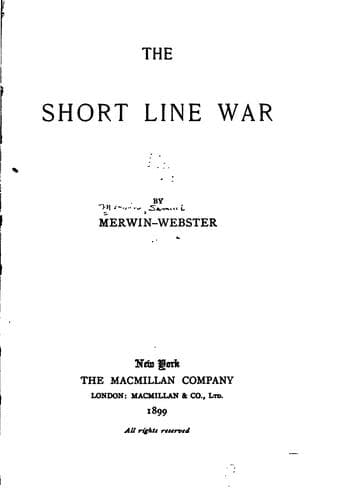
Historical fiction; Railroads -- History -- Fiction
Wing's office on the sixth floor of the Dartmouth was a beautifully
furnished suite, presided over by a boy in cut-steel buttons. Wing
himself was a dapper little man, a capitalist by necessity only, for
his money had been left to him. His one ambition was to collect all
the literature in all languages on the game of chess; a game by the way
which he himself did not play. “Mr. Wing had gone out to lunch about an
hour before,” said the boy in buttons. “Would Mr. West wait?” Harvey,
who knew Mr. Wing's luncheons of old, said no, but he would call again
in the afternoon. As he walked back to the elevator his eye fell upon
another office door which bore the freshly painted legend, “Frederick
McNally, Attorney-at-law.”
Harvey lunched at the Cafe Lyon, which is across the street from the
main entrance to the Dartmouth. The day was warm for late September, and
he selected a seat just inside the open door. From his table he could
see people hurrying in and out of the big office building. He watched
the crowd idly as he waited for his lunch, and finally his interest
shifted to the big doors, which seemed to have something human about
them, as they maliciously tried to catch the little messenger boys who
rushed between them as they swung.
Suddenly his attention came back to the crowd, centring on a party of
four men who turned into the great entrance. Three of them he knew, and
the fact that they were together suggested startling possibilities.
They were Wing, Thompson and William C. Porter of Chicago and Truesdale,
First Vice-President of the C. & S.C. and, this was the way Harvey
thought of him, father of the Miss Katherine Porter whose name was at
the bottom of the note in the blue envelope. Thompson, a fat, flaccid
man with a colorless beard, was laboriously holding the door open for
Mr. Porter, then he preceded little Mr. Wing. The fourth man was a
stranger to Harvey.
He was starting to follow them when the waiter came up with his order.
That made him pause, and a moment's reflection convinced him that he had
better wait. He decided that if the meeting of Porter with the two M.
& T. directors were not accidental they would be likely to be in
consultation for some time, and he would gain more by inquiring for
Mr. Wing at the expiration of a half hour than by doing it now. So
he lunched at leisure and then went back to the sixth floor of the
Dartmouth.
He was met by a rebuff from Buttons. “No, Mr. Wing had not come back
yet,” and again “Would Mr. West wait?” Harvey could think of nothing
better to do, so he sat down to think the matter out. He was puzzled,
for the three men were in the building, he felt sure. Then it came to
him. “Jove,” he murmured, “McNally! McNally was that fourth man.” He sat
back in his chair and tried to decide what to do.
Public-domain text, read in full here on John Shaqi.
Reviews
Reviews
No reviews yet
Be the first to share your thoughts on this work.
Join the Discussion
Join the discussion
Sign in to leave a comment or review.
Sign InorCreate an account