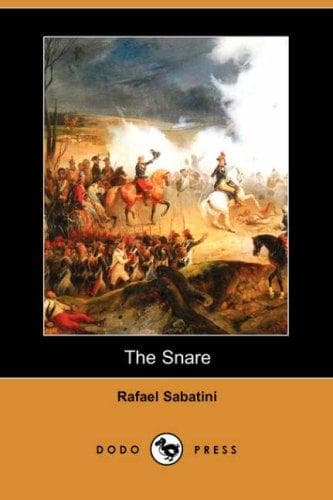
Adventure stories; British -- Portugal -- Fiction; Peninsular War, 1807-1814 -- Fiction
Produced by An Anonymous Project Gutenberg Volunteer
THE SNARE
By Rafael Sabatini
CONTENTS
I. THE AFFAIR AT TAVORA
II. THE ULTIMATUM
III. LADY O’MOY
IV. COUNT SAMOVAL
V. THE FUGITIVE
VI. MISS ARMYTAGE’S PEARLS
VII. THE ALLY
VIII. THE INTELLIGENCE OFFICER
IX. THE GENERAL ORDER
X. THE STIFLED QUARREL
XI. THE CHALLENGE
XII. THE DUEL
XIII. POLICHINELLE
XIV. THE CHAMPION
XV. THE WALLET
XVI. THE EVIDENCE
XVII. BITTER WATER
XVIII. FOOL’S MATE
XIX. THE TRUTH
XX. THE RESIGNATION
XXI. SANCTUARY
POSTSCRIPTUM
THE SNARE
CHAPTER I. THE AFFAIR AT TAVORA
It is established beyond doubt that Mr. Butler was drunk at the time.
This rests upon the evidence of Sergeant Flanagan and the troopers who
accompanied him, and it rests upon Mr. Butler’s own word, as we shall
see. And let me add here and now that however wild and irresponsible a
rascal he may have been, yet by his own lights he was a man of honour,
incapable of falsehood, even though it were calculated to save his skin.
I do not deny that Sir Thomas Picton has described him as a “thieving
blackguard.” But I am sure that this was merely the downright, rather
extravagant manner, of censure peculiar to that distinguished general,
and that those who have taken the expression at its purely literal value
have been lacking at once in charity and in knowledge of the caustic,
uncompromising terms of speech of General Picton whom Lord Wellington,
you will remember, called a rough, foulmouthed devil.
In further extenuation it may truthfully be urged that the whole hideous
and odious affair was the result of a misapprehension; although I cannot
go so far as one of Lieutenant Butler’s apologists and accept the
view that he was the victim of a deliberate plot on the part of his
too-genial host at Regoa. That is a misconception easily explained. This
host’s name happened to be Souza, and the apologist in question has very
rashly leapt at the conclusion that he was a member of that notoriously
intriguing family, of which the chief members were the Principal Souza,
of the Council of Regency at Lisbon, and the Chevalier Souza, Portuguese
minister to the Court of St. James’s. Unacquainted with Portugal, our
apologist was evidently in ignorance of the fact that the name of Souza
is almost as common in that country as the name of Smith in this. He may
also have been misled by the fact that Principal Souza did not neglect
to make the utmost capital out of the affair, thereby increasing the
difficulties with which Lord Wellington was already contending as a
result of incompetence and deliberate malice on the part both of the
ministry at home and of the administration in Lisbon.
Public-domain text, read in full here on John Shaqi.
Reviews
Reviews
No reviews yet
Be the first to share your thoughts on this work.
Join the Discussion
Join the discussion
Sign in to leave a comment or review.
Sign InorCreate an account