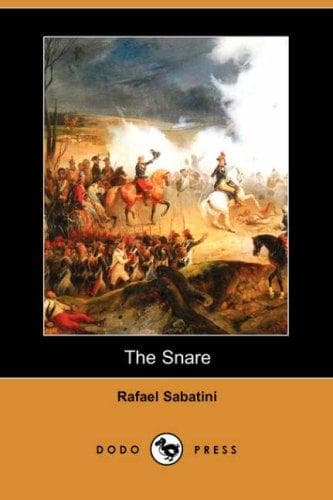
Adventure stories; British -- Portugal -- Fiction; Peninsular War, 1807-1814 -- Fiction
“General, I thank you. My country thanks you. You may be confident
of this issue.” He bowed gravely to O’Moy and then to Tremayne. “Your
Excellencies, I have the honour to wish you good-day.” He was shown out
by the orderly who had admitted him, and he departed well satisfied
in his patriotic heart that the crisis which he had always known to
be inevitable should have been reached at last. Yet, as he went, he
wondered why the Adjutant-General had looked so downcast, why his voice
had broken when he pledged his word that justice should be done upon
the offending British officer. That, however, was no concern of Dom
Miguel’s, and there was more than enough to engage his thoughts when
he came to consider the ultimatum to his Government with which he was
charged.
CHAPTER III. LADY O’MOY
Across the frontier in the northwest was gathering the third army of
invasion, some sixty thousand strong, commanded by Marshal Massena,
Prince of Esslingen, the most skilful and fortunate of all Napoleon’s
generals, a leader who, because he had never known defeat, had come to
be surnamed by his Emperor “the dear child of Victory.”
Wellington, at the head of a British force of little more than one
third of the French host, watched and waited, maturing his stupendous
strategic plan, which those in whose interests it had been conceived
had done so much to thwart. That plan was inspired by and based upon
the Emperor’s maxim that war should support itself; that an army on the
march must not be hampered and immobilised by its commissariat, but that
it must draw its supplies from the country it is invading; that it must,
in short, live upon that country.
Behind the British army and immediately to the north of Lisbon, in an
arc some thirty miles long, following the inflection of the hills from
the sea at the mouth of the Zizandre to the broad waters of the Tagus
at Alhandra, the lines of Torres Vedras were being constructed under the
direction of Colonel Fletcher and this so secretly and with such careful
measures as to remain unknown to British and Portuguese alike. Even
those employed upon the works knew of nothing save the section upon
which they happened to be engaged, and had no conception of the
stupendous and impregnable whole that was preparing.
Public-domain text, read in full here on John Shaqi.
Reviews
Reviews
No reviews yet
Be the first to share your thoughts on this work.
Join the Discussion
Join the discussion
Sign in to leave a comment or review.
Sign InorCreate an account