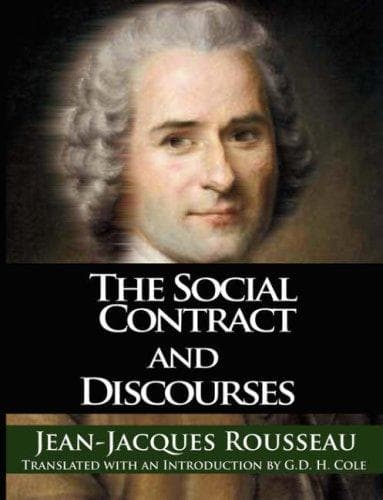
The social contract & discoursesRousseau, Jean-Jacques
Philosophy
The social contract & discourses
Rousseau, Jean-Jacques
Economics; Political science -- Early works to 1800; Social contract
The better the constitution of a State is, the more do public affairs
encroach on private in the minds of the citizens. Private affairs are
even of much less importance, because the aggregate of the common
happiness furnishes a greater proportion of that of each individual,
so that there is less for him to seek in particular cares. In a
well-ordered city every man flies to the assemblies: under a bad
government no one cares to stir a step to get to them, because no one
is interested in what happens there, because it is foreseen that the
general will will not prevail, and lastly because domestic cares are
all-absorbing. Good laws lead to the making of better ones; bad ones
bring about worse. As soon as any man says of the affairs of the State
_What does it matter to me?_ the State may be given up for lost.
The lukewarmness of patriotism, the activity of private interest, the
vastness of States, conquest and the abuse of government suggested
the method of having deputies or representatives of the people in
the national assemblies. These are what, in some countries, men have
presumed to call the Third Estate. Thus the individual interest of two
orders is put first and second; the public interest occupies only the
third place.
Sovereignty, for the same reason as makes it inalienable, cannot be
represented; it lies essentially in the general will, and will does not
admit of representation: it is either the same, or other; there is no
intermediate possibility. The deputies of the people, therefore, are
not and cannot be its representatives: they are merely its stewards,
and can carry through no definitive acts. Every law the people has not
ratified in person is null and void--is, in fact, not a law. The people
of England regards itself as free; but it is grossly mistaken; it is
free only during the election of members of parliament. As soon as they
are elected, slavery overtakes it, and it is nothing. The use it makes
of the short moments of liberty it enjoys shows indeed that it deserves
to lose them.
The idea of representation is modern; it comes to us from feudal
government, from that iniquitous and absurd system which degrades
humanity and dishonours the name of man. In ancient republics and even
in monarchies, the people never had representatives; the word itself
was unknown. It is very singular that in Rome, where the tribunes
were so sacrosanct, it was never even imagined that they could usurp
the functions of the people, and that in the midst of so great a
multitude they never attempted to pass on their own authority a single
plebiscitum. We can, however, form an idea of the difficulties caused
sometimes by the people being so numerous, from what happened in the
time of the Gracchi, when some of the citizens had to cast their votes
from the roofs of buildings.
Public-domain text, read in full here on John Shaqi.
Reviews
Reviews
No reviews yet
Be the first to share your thoughts on this work.
Elsewhere in the archive
Join the Discussion
Join the discussion
Sign in to leave a comment or review.
Sign InorCreate an account