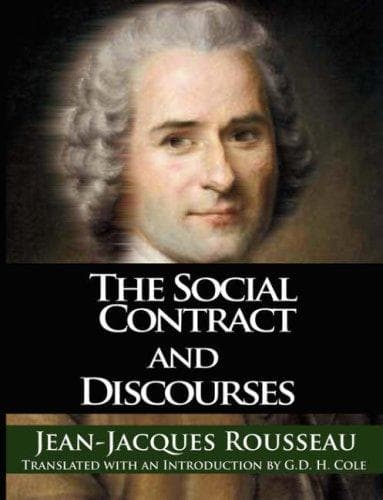
The social contract & discoursesRousseau, Jean-Jacques
Philosophy
The social contract & discourses
Rousseau, Jean-Jacques
Economics; Political science -- Early works to 1800; Social contract
But when the social bond begins to be relaxed and the State to grow
weak, when particular interests begin to make themselves felt and the
smaller societies to exercise an influence over the larger, the common
interest changes and finds opponents: opinion is no longer unanimous;
the general will ceases to be the will of all; contradictory views and
debates arise; and the best advice is not taken without question.
Finally, when the State, on the eve of ruin, maintains only a vain,
illusory and formal existence, when in every heart the social bond
is broken, and the meanest interest brazenly lays hold of the sacred
name of "public good," the general will becomes mute: all men, guided
by secret motives, no more give their views as citizens than if the
State had never been; and iniquitous decrees directed solely to private
interest get passed under the name of laws.
Does it follow from this that the general will is exterminated or
corrupted? Not at all: it is always constant, unalterable and pure; but
it is subordinated to other wills which encroach upon its sphere. Each
man, in detaching, his interest from the common interest, sees clearly
that he cannot entirely separate them; but his share in the public
mishaps seems to him negligible beside the exclusive good he aims at
making his own. Apart from this particular good, he wills the general
good in his own interest, as strongly as any one else. Even in selling
his vote for money, he does not extinguish in himself the general
will, but only eludes it. The fault he commits is that of changing the
state of the question, and answering something different from what he
is asked. Instead of saying, by his vote, "It is to the advantage of
the State," he says, "It is of advantage to this or that man or party
that this or that view should prevail." Thus the law of public order
in assemblies is not so much to maintain in them the general will as
to secure that the question be always put to it, and the answer always
given by it.
I could here set down many reflections on the simple right of voting
in every act of Sovereignty--a right which no-one can take from the
citizens--and also on the right of stating views, making proposals,
dividing and discussing, which the government is always most careful
to leave solely to its members; but this important subject would need a
treatise to itself, and it is impossible to say everything in a single
work.
CHAPTER II
VOTING
It may be seen, from the last chapter, that the way in which general
business is managed may give a clear enough indication of the actual
state of morals and the health of the body politic. The more concert
reigns in the assemblies, that is, the nearer opinion approaches
unanimity, the greater is the dominance of the general will. On
the other hand, long debates, dissensions and tumult proclaim the
ascendancy of particular interests and the decline of the State.
Public-domain text, read in full here on John Shaqi.
Reviews
Reviews
No reviews yet
Be the first to share your thoughts on this work.
Elsewhere in the archive
Join the Discussion
Join the discussion
Sign in to leave a comment or review.
Sign InorCreate an account