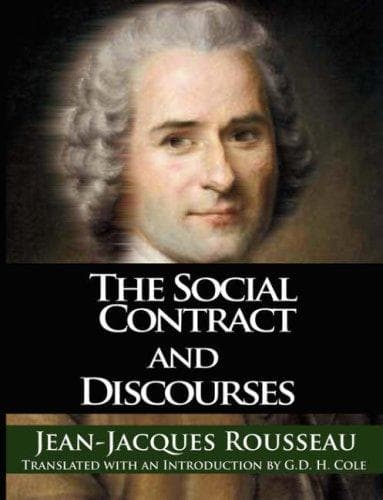
The social contract & discoursesRousseau, Jean-Jacques
Philosophy
The social contract & discourses
Rousseau, Jean-Jacques
Economics; Political science -- Early works to 1800; Social contract
The second is good in that it unites the divine cult with love of
the laws, and, making country the object of the citizens' adoration,
teaches them that service done to the State is service done to its
tutelary god. It is a form of theocracy, in which there can be no
pontiff save the prince, and no priests save the magistrates. To die
for one's country then becomes martyrdom; violation of its laws,
impiety; and to subject one who is guilty to public execration is to
condemn him to the anger of the gods: _Sacer estod_.
On the other hand, it is bad in that, being founded on lies and error,
it deceives men, makes them credulous and superstitious, and drowns the
true cult of the Divinity in empty ceremonial. It is bad, again, when
it becomes tyrannous and exclusive, and makes a people bloodthirsty and
intolerant, so that it breathes fire and slaughter, and regards as a
sacred act the killing of every one who does not believe in its gods.
The result is to place such a people in a natural state of war with all
others, so that its security is deeply endangered.
There remains therefore the religion of man or Christianity--not the
Christianity of to-day, but that of the Gospel, which is entirely
different. By means of this holy, sublime, and real religion all men,
being children of one God, recognise one another as brothers, and the
society that unites them is not dissolved even at death.
But this religion, having no particular relation to the body politic,
leaves the laws in possession of the force they have in themselves
without making any addition to it; and thus one of the great bonds that
unite society considered in severalty fails to operate. Nay, more, so
far from binding the hearts of the citizens to the State, it has the
effect of taking them away from all earthly things. I know of nothing
more contrary to the social spirit.
We are told that a people of true Christians would form the most
perfect society imaginable. I see in this supposition only one great
difficulty: that a society of true Christians would not be a society of
men.
I say further that such a society, with all its perfection, would be
neither the strongest nor the most lasting: the very fact that it was
perfect would rob it of its bond of union; the flaw that would destroy
it would lie in its very perfection.
Every one would do his duty; the people would be law-abiding, the
rulers just and temperate; the magistrates upright and incorruptible;
the soldiers would scorn death; there would be neither vanity nor
luxury. So far, so good; but let us hear more.
Public-domain text, read in full here on John Shaqi.
Reviews
Reviews
No reviews yet
Be the first to share your thoughts on this work.
Elsewhere in the archive
Join the Discussion
Join the discussion
Sign in to leave a comment or review.
Sign InorCreate an account