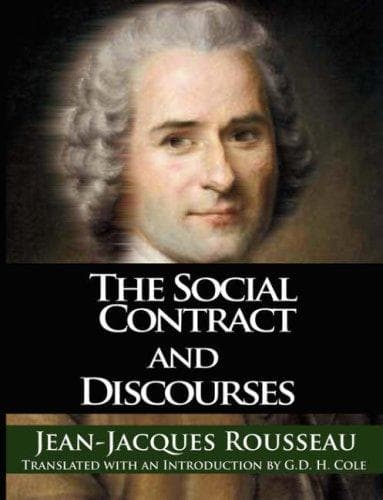
The social contract & discoursesRousseau, Jean-Jacques
Philosophy
The social contract & discourses
Rousseau, Jean-Jacques
Economics; Political science -- Early works to 1800; Social contract
Christianity as a religion is entirely spiritual, occupied solely with
heavenly things; the country of the Christian is not of this world. He
does his duty, indeed, but does it with profound indifference to the
good or ill success of his cares. Provided he has nothing to reproach
himself with, it matters little to him whether things go well or ill
here on earth. If the State is prosperous, he hardly dares to share
in the public happiness, for fear he may grow proud of his country's
glory; if the State is languishing, he blesses the hand of God that is
hard upon His people.
For the State to be peaceable and for harmony to be maintained, all the
citizens without exception would have to be good Christians; if by ill
hap there should be a single self-seeker or hypocrite, a Catiline or a
Cromwell, for instance, he would certainly get the better of his pious
compatriots. Christian charity does not readily allow a man to think
hardly of his neighbours. As soon as, by some trick, he has discovered
the art of imposing on them and getting hold of a share in the public
authority, you have a man established in dignity; it is the will of
God that he be respected: very soon you have a power; it is God's will
that it be obeyed: and if the power is abused by him who wields it,
it is the scourge wherewith God punishes His children. There would be
scruples about driving out the usurper: public tranquillity would have
to be disturbed, violence would have to be employed, and blood spilt;
all this accords ill with Christian meekness; and after all, in this
vale of sorrows, what does it matter whether we are free men or serfs?
The essential thing is to get to heaven, and resignation is only an
additional means of doing so.
If war breaks out with another State, the citizens march readily out
to battle; not one of them thinks of flight; they do their duty, but
they have no passion for victory; they know better how to die than
how to conquer. What does it matter whether they win or lose? Does
not Providence know better than they what is meet for them? Only
think to what account a proud, impetuous and passionate enemy could
turn their stoicism! Set over against them those generous peoples who
were devoured by ardent love of glory and of their country, imagine
your Christian republic face to face with Sparta or Rome: the pious
Christians will be beaten, crushed and destroyed, before they know
where they are, or will owe their safety only to the contempt their
enemy will conceive for them. It was to my mind a fine oath that was
taken by the soldiers of Fabius, who swore, not to conquer or die, but
to come back victorious--and kept their oath. Christians, would never
have taken such an oath; they would have looked on it as tempting God.
Public-domain text, read in full here on John Shaqi.
Reviews
Reviews
No reviews yet
Be the first to share your thoughts on this work.
Elsewhere in the archive
Join the Discussion
Join the discussion
Sign in to leave a comment or review.
Sign InorCreate an account