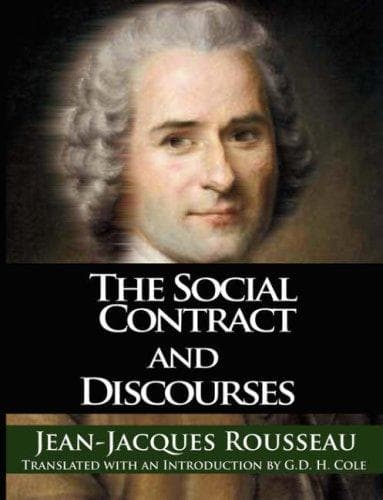
The social contract & discoursesRousseau, Jean-Jacques
Philosophy
The social contract & discourses
Rousseau, Jean-Jacques
Economics; Political science -- Early works to 1800; Social contract
So long as government and law provide for the security and well-being
of men in their common life, the arts, literature and the sciences,
less despotic though perhaps more powerful, fling garlands of flowers
over the chains which weigh them down. They stifle in men's breasts
that sense of original liberty, for which they seem to have been born;
cause them to love their own slavery, and so make of them what is
called a civilised people.
Necessity raised up thrones; the arts and sciences have made them
strong. Powers of the earth, cherish all talents and protect those who
cultivate them.[1] Civilised peoples, cultivate such pursuits: to them,
happy slaves, you owe that delicacy and exquisiteness of taste, which
is so much your boast, that sweetness of disposition and urbanity of
manners which make intercourse so easy and agreeable among you--in a
word, the appearance of all the virtues, without being in possession of
one of them.
It was for this sort of accomplishment, which is by so much the more
captivating as it seems less affected, that Athens and Rome were
so much distinguished in the boasted times of their splendour and
magnificence: and it is doubtless in the same respect that our own age
and nation will excel all periods and peoples. An air of philosophy
without pedantry; an address at once natural and engaging, distant
equally from Teutonic clumsiness and Italian pantomime; these are
the effects of a taste acquired by liberal studies and improved by
conversation with the world. What happiness would it be for those who
live among us, if our external appearance were always a true mirror of
our hearts; if decorum were but virtue; if the maxims we professed were
the rules of our conduct; and if real philosophy were inseparable from
the title of a philosopher! But so many good qualities too seldom go
together; virtue rarely appears in so much pomp and state.
Richness of apparel may proclaim the man of fortune, and elegance the
man of taste; but true health and manliness are known by different
signs. It is under the home-spun of the labourer, and not beneath the
gilt and tinsel of the courtier, that we should look for strength and
vigour of body.
External ornaments are no less foreign to virtue, which is the strength
and activity of the mind. The honest man is an athlete, who loves to
wrestle stark naked; he scorns all those vile trappings, which prevent
the exertion of his strength, and were, for the most part, invented
only to conceal some deformity.
Before art had moulded our behaviour, and taught our passions to speak
an artificial language, our morals were rude but natural; and the
different ways in which we behaved proclaimed at the first glance the
difference of our dispositions. Human nature was not at bottom better
then than now; but men found their security in the ease with which
they could see through one another, and this advantage, of which we no
longer feel the value, prevented their having many vices.
Public-domain text, read in full here on John Shaqi.
Reviews
Reviews
No reviews yet
Be the first to share your thoughts on this work.
Elsewhere in the archive
Join the Discussion
Join the discussion
Sign in to leave a comment or review.
Sign InorCreate an account