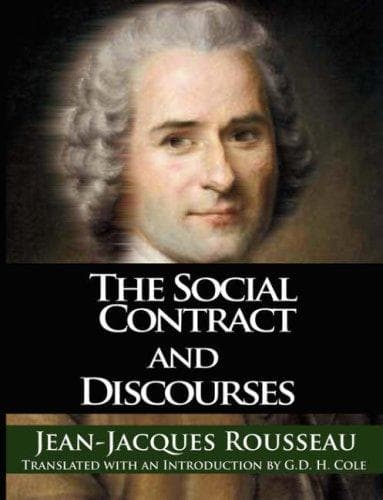
The social contract & discoursesRousseau, Jean-Jacques
Philosophy
The social contract & discourses
Rousseau, Jean-Jacques
Economics; Political science -- Early works to 1800; Social contract
What then have I to fear? The sagacity of the assembly before which
I am pleading? That, I acknowledge, is to be feared; but rather on
account of faults of construction than of the views I hold. Just
sovereigns have never hesitated to decide against themselves in
doubtful cases; and indeed the most advantageous situation in which a
just claim can be, is that of being laid before a just and enlightened
arbitrator, who is judge in his own case.
To this motive, which encouraged me, I may add another which finally
decided me. And this is, that as I have upheld the cause of truth to
the best of my natural abilities, whatever my apparent success, there
is one reward which cannot fail me. That reward I shall find in the
bottom of my heart.
THE FIRST PART
It is a noble and beautiful spectacle to see man raising himself, so
to speak, from nothing by his own exertions; dissipating, by the light
of reason, all the thick clouds in which he was by nature enveloped;
mounting above himself; soaring in thought even to the celestial
regions; like the sun, encompassing with giant strides the vast extent
of the universe; and, what is still grander and more wonderful, going
back into himself, there to study man and get to know his own nature,
his duties and his end. All these miracles we have seen renewed within
the last few generations.
Europe had relapsed into the barbarism of the earliest ages; the
inhabitants of this part of the world, which is at present so highly
enlightened, were plunged, some centuries ago, in a state still-worse
than ignorance. A scientific jargon, more despicable than mere
ignorance, had usurped the name of knowledge, and opposed an almost
invincible obstacle to its restoration.
Things had come to such a pass, that it required a complete revolution
to bring men back to common sense. This came at last from the quarter
from which it was least to be expected. It was the stupid Mussulman,
the eternal scourge of letters, who was the immediate cause of their
revival among us. The fall of the throne of Constantine brought to
Italy the relics of ancient Greece; and with these precious spoils
France in turn was enriched. The sciences soon followed literature,
and the art of thinking joined that of writing: an order which may
seem strange, but is perhaps only too natural. The world now began to
perceive the principal advantage of an intercourse with the Muses, that
of rendering mankind more sociable by inspiring them with the desire to
please one another with performances worthy of their mutual approbation.
The mind, as well as the body, has its needs: those of the body are the
basis of society, those of the mind its ornaments.
Public-domain text, read in full here on John Shaqi.
Reviews
Reviews
No reviews yet
Be the first to share your thoughts on this work.
Elsewhere in the archive
Join the Discussion
Join the discussion
Sign in to leave a comment or review.
Sign InorCreate an account