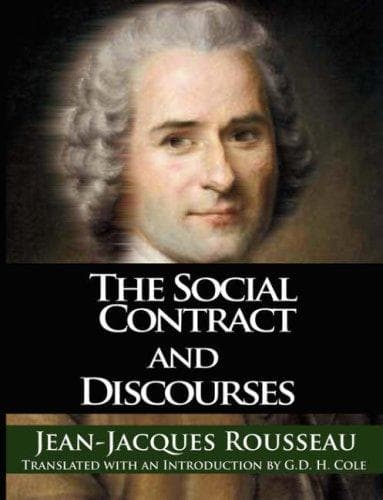
The social contract & discoursesRousseau, Jean-Jacques
Philosophy
The social contract & discourses
Rousseau, Jean-Jacques
Economics; Political science -- Early works to 1800; Social contract
What would the great soul of Fabricius have felt, if it had been
his misfortune to be called back to life, when he saw the pomp and
magnificence of that Rome, which his arm had saved from ruin, and
his honourable name made more illustrious than all its conquests.
"Ye gods!" he would have said, "what has become of those thatched
roofs and rustic hearths, which were formerly the habitations of
temperance and virtue? What fatal splendour has succeeded the ancient
Roman simplicity? What is this foreign language, this effeminacy of
manners? What is the meaning of these statues, paintings and buildings?
Fools, what have you done? You, the lords of the earth, have made
yourselves the slaves of the frivolous nations you have subdued.
You are governed by rhetoricians, and it has been only to enrich
architects, painters, sculptors and stage-players that you have watered
Greece and Asia with your blood. Even the spoils of Carthage are the
prize of a flute-player. Romans! Romans! make haste to demolish those
amphitheatres, break to pieces those statues, burn those paintings;
drive from among you those slaves who keep you in subjection, and whose
fatal arts are corrupting your morals. Let other hands make themselves
illustrious by such vain talents; the only talent worthy of Rome is
that of conquering the world and making virtue its ruler. When Cyneas
took the Roman senate for an assembly of kings, he was not struck by
either useless pomp or studied elegance. He heard there none of that
futile eloquence, which is now the study and the charm of frivolous
orators. What then was the majesty that Cyneas beheld? Fellow citizens,
he saw the noblest sight that ever existed under heaven, a sight which
not all your riches or your arts can show; an assembly of two hundred
virtuous men, worthy to command in Rome, and to govern the world."
But let pass the distance of time and place, and let us see what has
happened in our own time and country; or rather let us banish odious
descriptions that might offend our delicacy, and spare ourselves the
pains of repeating the same tilings under different names. It was not
for nothing that I invoked the Manes of Fabricius; for what have I
put into his mouth, that might not have come with as much propriety
from Louis the Twelfth or Henry the Fourth? It is true that in France
Socrates would not have drunk the hemlock, but he would have drunk of
a potion infinitely more bitter, of insult, mockery and contempt a
hundred times worse than death.
Public-domain text, read in full here on John Shaqi.
Reviews
Reviews
No reviews yet
Be the first to share your thoughts on this work.
Elsewhere in the archive
Join the Discussion
Join the discussion
Sign in to leave a comment or review.
Sign InorCreate an account