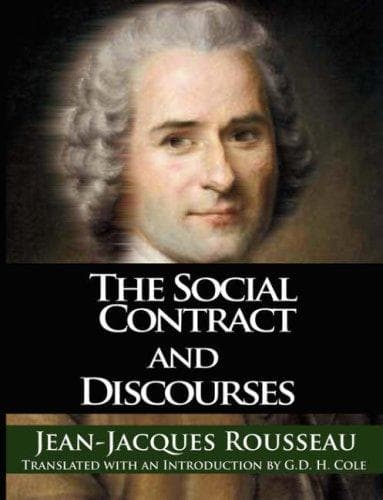
The social contract & discoursesRousseau, Jean-Jacques
Philosophy
The social contract & discourses
Rousseau, Jean-Jacques
Economics; Political science -- Early works to 1800; Social contract
"None of us, neither the sophists, nor the poets, nor the orators, nor
the artists, nor I, know what is the nature of the _true_, the _good_,
or the _beautiful_. But there is this difference between us; that,
though none of these people know anything, they all think they know
something; whereas for my part, if I know nothing, I am at least in no
doubt of my ignorance. So the superiority of wisdom, imputed to me by
the oracle, is reduced merely to my being fully convinced that I am
ignorant of what I do not know."
Thus we find Socrates, the wisest of men in the judgment of the god,
and the most learned of all the Athenians in the opinion of all Greece,
speaking in praise of ignorance. Were he alive now, there is little
reason to think that our modern scholars and artists would induce him
to change his mind. No, gentlemen, that honest man would still persist
in despising our vain sciences. He would lend no aid to swell the flood
of books that flows from every quarter: he would leave to us, as he did
to his disciples, only the example and memory of his virtues; that is
the noblest method of instructing mankind.
Socrates had begun at Athens, and the elder Cato proceeded at Rome, to
inveigh against those seductive and subtle Greeks, who corrupted the
virtue and destroyed the courage of their fellow-citizens: culture,
however, prevailed. Rome was filled with philosophers and orators,
military discipline was neglected, agriculture was held in contempt,
men formed sects, and forgot their country. To the sacred names of
liberty, disinterestedness and obedience to law, succeeded those of
Epicurus, Zeno and Arcesilaus. It was even a saying among their own
philosophers that since learned men appeared among them, honest men had
been in eclipse. Before that time the Romans were satisfied with the
practice of virtue; they were undone when they began to study it.
Public-domain text, read in full here on John Shaqi.
Reviews
Reviews
No reviews yet
Be the first to share your thoughts on this work.
Elsewhere in the archive
Join the Discussion
Join the discussion
Sign in to leave a comment or review.
Sign InorCreate an account