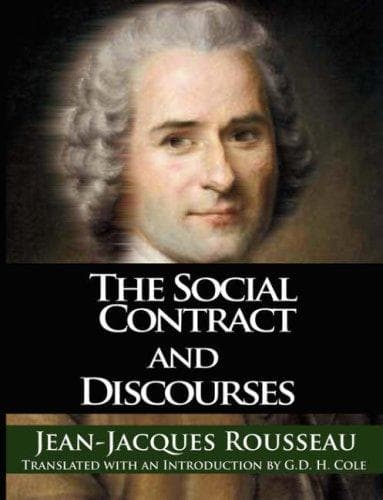
The social contract & discoursesRousseau, Jean-Jacques
Philosophy
The social contract & discourses
Rousseau, Jean-Jacques
Economics; Political science -- Early works to 1800; Social contract
What a variety of dangers surrounds us! What a number of wrong paths
present themselves in the investigation of the sciences! Through how
many errors, more perilous than truth itself is useful, must we not
pass to arrive at it? The disadvantages we lie under are evident; for
falsehood is capable of an infinite variety of combinations; but the
truth has only one manner of being. Besides, where is the man who
sincerely desires to find it? Or even admitting his good will, by
what characteristic marks is he sure of knowing it? Amid the infinite
diversity of opinions where is the criterion[2] by which we may
certainly judge of it? Again, what is still more difficult, should we
even be fortunate enough to discover it, who among us will know how to
make right use of it?
If our sciences are futile in the objects they propose, they are
no less dangerous in the effects they produce. Being the effect of
idleness, they generate idleness in their turn; and an irreparable
loss of time is the first prejudice which they must necessarily cause
to society. To live without doing some good is a great evil as well in
the political as in the moral world; and hence every useless citizen
should be regarded as a pernicious person. Tell me then, illustrious
philosophers, of whom we learn the ratios in which attraction acts in
vacuo; and in the revolution of the planets, the relations of spaces
traversed in equal times; by whom we are taught what curves have
conjugate points, points of inflexion, and cusps; how the soul and body
correspond, like two clocks, without actual communication; what planets
may be inhabited; and what insects reproduce in an extraordinary
manner. Answer me, I say, you from whom we receive all this sublime
information, whether we should have been less numerous, worse governed,
less formidable, less flourishing, or more perverse, supposing you had
taught us none of all these fine things.
Reconsider therefore the importance of your productions; and, since
the labours of the most enlightened of our learned men and the best of
our citizens are of so little utility, tell us what we ought to think
of that numerous herd of obscure writers and useless litterateurs, who
devour without any return the substance of the State.
Useless, do I say? Would God they were! Society would be more peaceful,
and morals less corrupt. But these vain and futile declaimers go forth
on all sides, armed with their fatal paradoxes, to sap the foundations
of our faith, and nullify virtue. They smile contemptuously at such
old names as patriotism and religion, and consecrate their talents and
philosophy to the destruction; and defamation of all that men hold
sacred. Not that they bear any real hatred to virtue or dogma; they are
the enemies of public opinion alone; to bring them to the foot of the
altar, it would be enough to banish them to a land of atheists. What
extravagancies will not the rage of singularity induce men to commit!
Public-domain text, read in full here on John Shaqi.
Reviews
Reviews
No reviews yet
Be the first to share your thoughts on this work.
Elsewhere in the archive
Join the Discussion
Join the discussion
Sign in to leave a comment or review.
Sign InorCreate an account