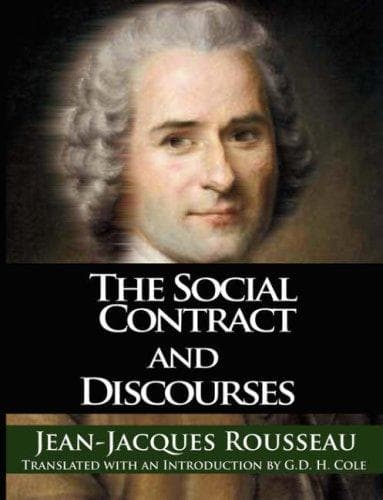
The social contract & discoursesRousseau, Jean-Jacques
Philosophy
The social contract & discourses
Rousseau, Jean-Jacques
Economics; Political science -- Early works to 1800; Social contract
The monarchy of Cyrus was conquered by thirty thousand men, led by a
prince poorer than the meanest of Persian Satraps: in like manner the
Scythians, the poorest of all nations, were able to resist the most
powerful monarchs of the universe. When two famous republics contended
for the empire of the world, the one rich and the other poor, the
former was subdued by the latter. The Roman empire in its turn, after
having engulfed all the riches of the universe, fell a prey to peoples
who knew not even what riches were. The Franks conquered the Gauls, and
the Saxons England, without any other treasures than their bravery and
their poverty. A band of poor mountaineers, whose whole cupidity was
confined to the possession of a few sheep-skins, having first given a
check to the arrogance of Austria, went on to crush the opulent and
formidable house of Burgundy, which at that time made the potentates
of Europe tremble. In short, all the power and wisdom of the heir of
Charles the Fifth, backed by all the treasures of the Indies, broke
before a few herring-fishers. Let our politicians condescend to lay
aside their calculations for a moment, to reflect on these examples;
let them learn for once that money, though it buys everything else,
cannot buy morals and citizens. What then is the precise point in
dispute about luxury? It is to know which is most advantageous to
empires, that their existence should be brilliant and momentary,
or virtuous and lasting? I say brilliant, but with what lustre! A
taste for ostentation never prevails in the same minds as a taste
for honesty. No, it is impossible that understandings, degraded by a
multitude of futile cares, should ever rise to what is truly great and
noble; even if they had the strength, they would want the courage.
Every artist loves applause. The praise of his contemporaries is the
most valuable part of his recompense. What then will he do to obtain
it, if he have the misfortune to be born among a people, and at a
time, when learning is in vogue, and the superficiality of youth is
in a position to lead the fashion; when men have sacrificed their
taste to those who tyrannise over their liberty, and one sex dare not
approve anything but what is proportionate to the pusillanimity of
the other;[3] when the greatest masterpieces of dramatic poetry are
condemned, and the noblest of musical productions neglected? This is
what he will do. He will lower his genius to the level of the age, and
will rather submit to compose mediocre works, that will be admired
during his life-time, than labour at sublime achievements which will
not be admired till long after he is dead. Let the famous Voltaire tell
us how many nervous and masculine beauties he has sacrificed to our
false delicacy, and how much that is great and noble, that spirit of
gallantry, which delights in what is frivolous and petty, has cost him.
Public-domain text, read in full here on John Shaqi.
Reviews
Reviews
No reviews yet
Be the first to share your thoughts on this work.
Elsewhere in the archive
Join the Discussion
Join the discussion
Sign in to leave a comment or review.
Sign InorCreate an account