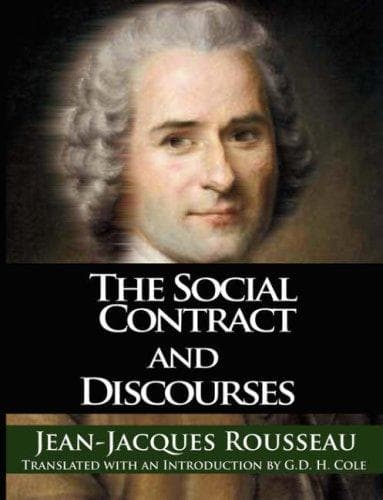
The social contract & discoursesRousseau, Jean-Jacques
Philosophy
The social contract & discourses
Rousseau, Jean-Jacques
Economics; Political science -- Early works to 1800; Social contract
These wise institutions, confirmed by his august successor and
imitated by all the kings of Europe, will serve at least to restrain
men of letters, who, all aspiring to the honour of being admitted
into these Academies, will keep watch over themselves, and endeavour
to make themselves worthy of such honour by useful performances and
irreproachable morals. Those Academies also, which, in proposing prizes
for literary merit, make choice of such subjects as are calculated to
arouse the love of virtue in the hearts of citizens, prove that it
prevails in themselves, and must give men the rare and real pleasure of
finding learned societies devoting themselves to the enlightenment of
mankind, not only by agreeable exercises of the intellect, but also by
useful instructions.
An objection which may be made is, in fact, only an additional proof of
my argument. So much precaution proves but too evidently the need for
it. We never seek remedies for evils that do not exist. Why, indeed,
must these bear all the marks of ordinary remedies, on account of their
inefficacy? The numerous establishments in favour of the learned are
only adapted to make men mistake the objects of the sciences, and turn
men's attention to the cultivation of them. One would be inclined to
think, from the precautions everywhere taken, that we are overstocked
with husbandmen, and are afraid of a shortage of philosophers. I
will not venture here to enter into a comparison between agriculture
and philosophy, as they would not bear it. I shall only ask What is
philosophy? What is contained in the writings of the most celebrated
philosophers? What are the lessons of these friends of wisdom. To hear
them, should we not take them for so many mountebanks, exhibiting
themselves in public, and crying out, _Here, Here, come to me, I am
the only true doctor_? One of them teaches that there is no such thing
as matter, but that everything exists only in representation. Another
declares that there is no other substance than matter, and no other
God than the world itself. A third tells you that there are no such
things as virtue and vice, and that moral good and evil are chimeras;
while a fourth informs you that men are only beasts of prey, and may
conscientiously devour one another. Why, my great philosophers, do you
not reserve these wise and profitable lessons for your friends and
children? You would soon reap the benefit of them, nor should we be
under any apprehension of our own becoming your disciples.
Public-domain text, read in full here on John Shaqi.
Reviews
Reviews
No reviews yet
Be the first to share your thoughts on this work.
Elsewhere in the archive
Join the Discussion
Join the discussion
Sign in to leave a comment or review.
Sign InorCreate an account