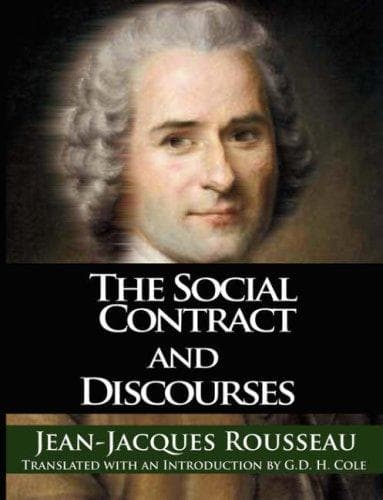
The social contract & discoursesRousseau, Jean-Jacques
Philosophy
The social contract & discourses
Rousseau, Jean-Jacques
Economics; Political science -- Early works to 1800; Social contract
Whence arise all those abuses, unless it be from that fatal inequality
introduced among men by the difference of talents and the cheapening
of virtue? This is the most evident effect of all our studies, and the
most dangerous of all their consequences. The question is no longer
whether a man is honest, but whether he is clever. We do not ask
whether a book is useful, but whether it is well-written. Rewards are
lavished on wit and ingenuity, while virtue is left unhonoured. There
are a thousand prizes for fine discourses, and none for good actions.
I should be glad, however, to know whether the honour attaching to the
best discourse that ever wins the prize in this Academy is comparable
with the merit of having founded the prize.
A wise man does not go in chase of fortune; but he is by no means
insensible to glory, and when he sees it so ill distributed, his
virtue, which might have been animated by a little emulation, and
turned to the advantage of society, droops and dies away in obscurity
and indigence. It is for this reason that the agreeable arts must in
time everywhere be preferred to the useful; and this truth has been but
too much confirmed since the revival of the arts and sciences. We have
physicists, geometricians, chemists, astronomers, poets, musicians, and
painters in plenty; but we have no longer a citizen among us; or if
there be found a few scattered over our abandoned countryside, they are
left to perish there unnoticed and neglected. Such is the condition to
which we are reduced, and such are our feelings towards those who give
us our daily bread, and our children milk.
I confess, however, that the evil is not so great as it might
have become. The eternal providence, in placing salutary simples
beside noxious plants, and making poisonous animals contain their
own antidote, has taught the sovereigns of the earth, who are its
ministers, to imitate its wisdom. It is by following this example that
the truly great monarch, to whose glory every age will add new lustre,
drew from the very bosom of the arts and sciences, the very fountains
of a thousand lapses from rectitude, those famous societies, which,
while they are depositaries of the dangerous trust of human knowledge,
are yet the sacred guardians of morals, by the attention they pay to
their maintenance among themselves in all their purity, and by the
demands which they make on every member whom they admit.
Public-domain text, read in full here on John Shaqi.
Reviews
Reviews
No reviews yet
Be the first to share your thoughts on this work.
Elsewhere in the archive
Join the Discussion
Join the discussion
Sign in to leave a comment or review.
Sign InorCreate an account