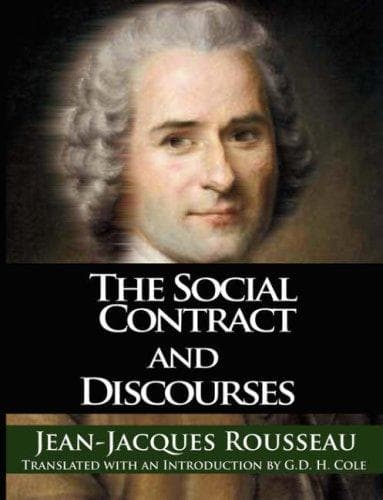
The social contract & discoursesRousseau, Jean-Jacques
Philosophy
The social contract & discourses
Rousseau, Jean-Jacques
Economics; Political science -- Early works to 1800; Social contract
But if the progress of the arts and sciences has added nothing to our
real happiness; if it has corrupted our morals, and if that corruption
has vitiated our taste, what are we to think of the herd of text-book
authors, who have removed those impediments which nature purposely laid
in the way to the Temple of the Muses, in order to guard its approach
and try the powers of those who might be tempted to seek knowledge?
What are we to think of those compilers who have indiscreetly broken
open the door of the sciences, and introduced into their sanctuary a
populace unworthy to approach it, when it was greatly to be wished that
all who should be found incapable of making a considerable progress in
the career of learning should have been repulsed at the entrance, and
thereby cast upon those arts which are useful to society. A man who
will be all his life a bad versifier, or a third-rate geometrician,
might have made nevertheless an excellent clothier. Those whom nature
intended for her disciples have not needed masters. Bacon, Descartes
and Newton, those teachers of mankind, had themselves no teachers.
What guide indeed could have taken them so far as their sublime
genius directed them? Ordinary masters would only have cramped their
intelligence, by confining it within the narrow limits of their own
capacity. It was from the obstacles they met with at first, that they
learned to exert themselves, and bestirred themselves to traverse the
vast field which they covered. If it be proper to allow some men to
apply themselves to the study of the arts and sciences, it is only
those who feel themselves able to walk alone in their footsteps and to
outstrip them. It belongs only to these few to raise monuments to the
glory of the human understanding. But if we are desirous that nothing
should be above their genius, nothing should be beyond their hopes.
This is the only encouragement they require. The soul insensibly adapts
itself to the objects on which it is employed, and thus it is that
great occasions produce great men. The greatest orator in the world
was Consul of Rome, and perhaps the greatest of philosophers Lord
Chancellor of England. Can it be conceived that, if the former had
only been a professor at some University, and the latter a pensioner
of some Academy, their works would not have suffered from their
situation. Let not princes disdain to admit into their councils those
who are most capable of giving them good advice. Let them renounce the
old prejudice, which was invented by the pride of the great, that the
art of governing mankind is more difficult than that of instructing
them; as if it was easier to induce men to do good voluntarily, than
to compel them to it by force. Let the learned of the first rank find
an honourable refuge in their courts; let them there enjoy the only
recompense worthy of them, that of promoting by their influence the
happiness of the peoples they have enlightened by their wisdom. It is
Public-domain text, read in full here on John Shaqi.
Reviews
Reviews
No reviews yet
Be the first to share your thoughts on this work.
Elsewhere in the archive
Join the Discussion
Join the discussion
Sign in to leave a comment or review.
Sign InorCreate an account