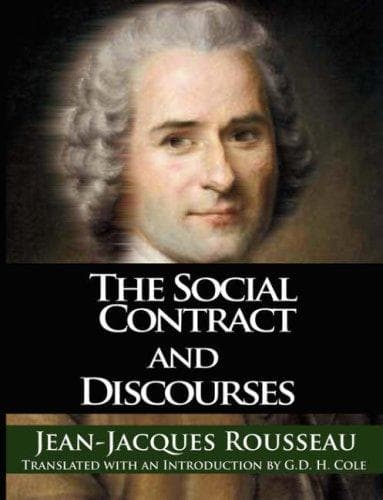
The social contract & discoursesRousseau, Jean-Jacques
Philosophy
The social contract & discourses
Rousseau, Jean-Jacques
Economics; Political science -- Early works to 1800; Social contract
by this means only that we are likely to see what virtue, science and
authority can do, when animated by the noblest emulation, and working
unanimously for the happiness of mankind.
But so long as power alone is on one side, and knowledge and
Understanding alone on the other, the learned will seldom make great
objects their study, princes will still more rarely do great actions,
and the peoples will continue to be, as they are, mean, corrupt and
miserable.
As for us, ordinary men, on whom Heaven has not been pleased to bestow
such great talents; as we are not destined to reap such glory, let
us remain in our obscurity. Let us not covet a reputation we should
never attain, and which, in the present state of things, would never
make up to us for the trouble it would have cost us, even if we were
fully qualified to obtain it. Why should we build our happiness on the
opinions of others, when we can find it in our own hearts? Let us leave
to others the task of instructing mankind in their duty, and confine
ourselves to the discharge of our own. We have no occasion for greater
knowledge than this.
Virtue! sublime science of simple minds, are such industry and
preparation needed if we are to know you? Are not your principles
graven on every heart? Need we do more, to learn your laws, than
examine ourselves, and listen to the voice of conscience, when the
passions are silent?
This is the true philosophy, with which we must learn to be content,
without envying the fame of those celebrated men, whose names are
immortal in the republic of letters. Let us, instead of envying them,
endeavour to make, between them and us, that honourable distinction
which was formerly seen to exist between two great peoples, that the
one knew how to speak, and the other how to act, aright.
[1] It is easy to see the allegory in the fable of Prometheus: and it
does not appear that the Greeks, who chained him to the Caucasus, had a
better opinion of him than the Egyptians had of their god Theutus. The
Satyr, says an ancient fable, the first time he saw a fire, was going
to kiss and embrace it; but Prometheus cried out to him to forbear, or
his beard would rue it. It burns, says he, everything that touches it.
[2] The less we know, the more we think we know. The peripatetics
doubted of nothing. Did not Descartes construct the universe with cubes
and vortices? And is there in all Europe one single physicist who does
not boldly explain the inexplicable mysteries of electricity, which
will, perhaps, be for ever the despair of real philosophers?
Public-domain text, read in full here on John Shaqi.
Reviews
Reviews
No reviews yet
Be the first to share your thoughts on this work.
Elsewhere in the archive
Join the Discussion
Join the discussion
Sign in to leave a comment or review.
Sign InorCreate an account