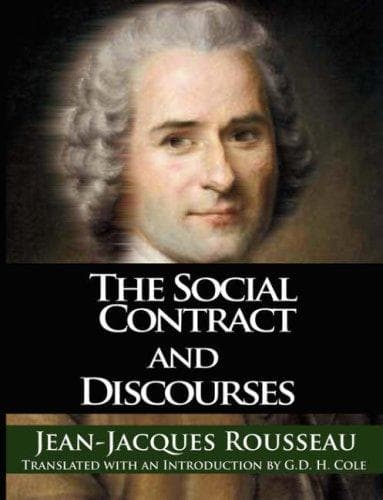
The social contract & discoursesRousseau, Jean-Jacques
Philosophy
The social contract & discourses
Rousseau, Jean-Jacques
Economics; Political science -- Early works to 1800; Social contract
Deign, most honourable, magnificent and sovereign lords, to receive,
and with equal goodness, this respectful testimony of the interest I
take in your common prosperity. And, if I have been so unhappy as to
be guilty of any indiscreet transport in this glowing effusion of my
heart, I beseech you to pardon me, and to attribute it to the tender
affection of a true patriot, and to the ardent and legitimate zeal of
a man, who can imagine for himself no greater felicity than to see you
happy.
Most honourable, magnificent and sovereign lords, I am, with the most
profound respect,
Your most humble and obedient servant and fellow-citizen.
J. J. ROUSSEAU.
_Chambéry,_
_June 12, 1754._
PREFACE
Of all human sciences the most useful and most imperfect appears
to me to be that of mankind: and I will venture to say, the single
inscription on the Temple of Delphi contained a precept more difficult
and more important than is to be found in all the huge volumes that
moralists have ever written. I consider the subject of the following
discourse as one of the most interesting questions philosophy
can propose, and unhappily for us, one of, the most thorny that
philosophers can have to solve. For how shall we know the source of
inequality between men, if we do not begin by knowing mankind? And
how shall man hope to see himself as nature made him, across all the
changes which the succession of place and time must have produced in
his original constitution? How can he distinguish what is fundamental
in his nature from the changes and additions which his circumstances
and the advances he has made have introduced to modify his primitive
condition? Like the statue of Glaucus, which was so disfigured by time,
seas and tempests, that it looked more like a wild beast than a god,
the human soul, altered in society by a thousand causes perpetually
recurring, by the acquisition of a multitude of truths and errors,
by the changes happening to the constitution of the body, and by
the continual jarring of the passions, has, so to speak, changed in
appearance, so as to be hardly recognisable. Instead of a being,
acting constantly from fixed and invariable principles, instead of
that celestial and majestic simplicity, impressed on it by its divine
Author, we find in it only the frightful contrast of passion mistaking
itself for reason, and of understanding grown delirious.
It is still more cruel that, as every advance made by the human species
removes it still farther from its primitive state, the more discoveries
we make, the more we deprive ourselves of the means of making the most
important of all. Thus it is, in one sense, by our very study of man,
that the knowledge of him is put out of our power.
Public-domain text, read in full here on John Shaqi.
Reviews
Reviews
No reviews yet
Be the first to share your thoughts on this work.
Elsewhere in the archive
Join the Discussion
Join the discussion
Sign in to leave a comment or review.
Sign InorCreate an account